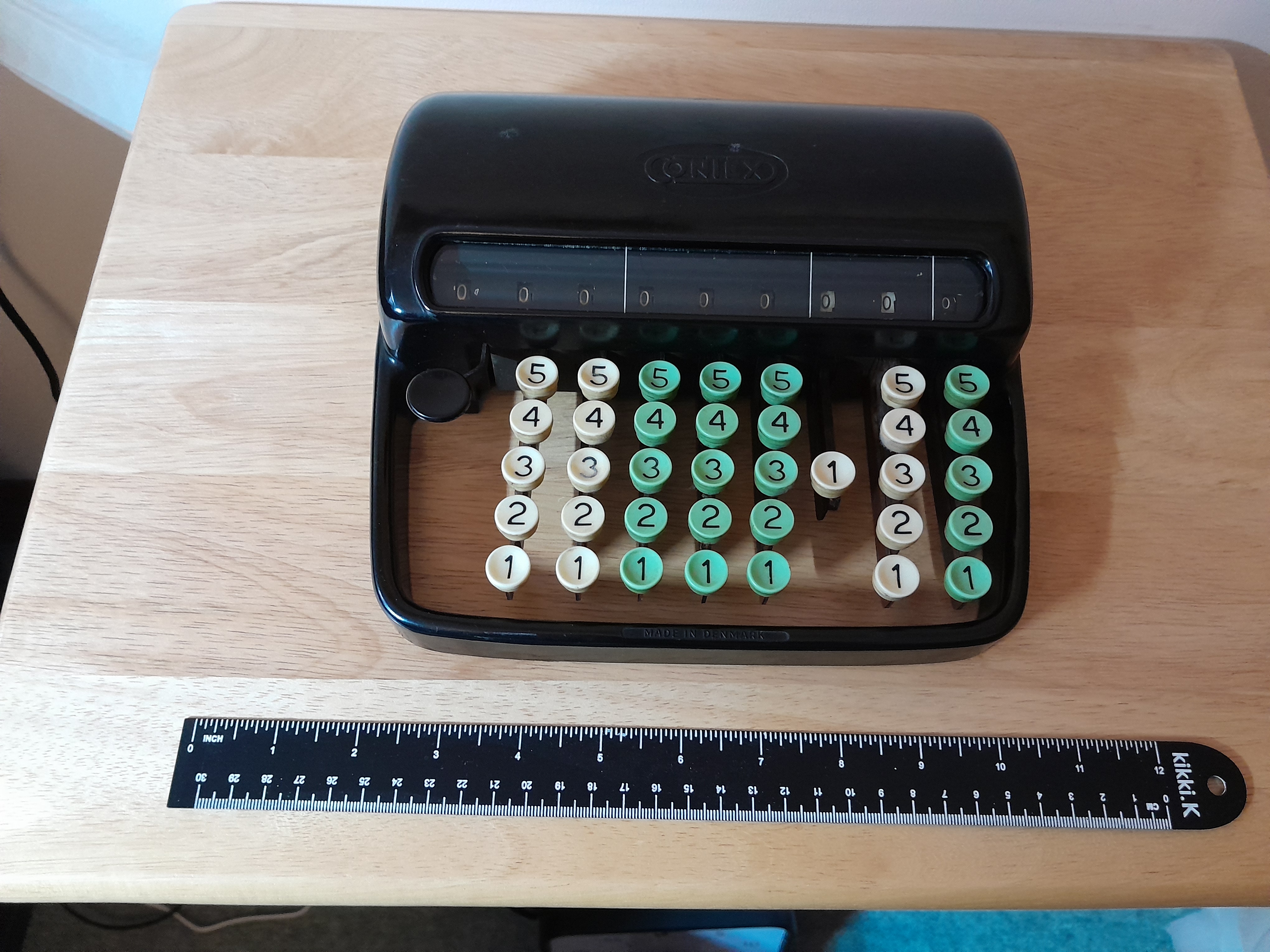
CONTEX ADDING MACHINE. Made in Denmark. Serial number 122395. Series A . Year approx 1946 – 1960. This old adding machine is for the pre decimal
system of pounds; shillings and pence. It has 5 rows of pound buttons and provision for a total answer of 6 figures to provide a final answer
of £999,999 and 19 shillings and 11 pence.
In common with all the comptometers that I show here, or adding machines as they are better known as, is that they all have half a keyboard that allows only the keys of 1 to 5 to be entered. If you want to enter a figure greater than 5, say 8, then you can press any combination you like, eg 6+2, 5+3, 4+4.
There is no memory so that if a mistake is made, or your concentration is interrupted, then you have to start all over again. To reset to nil the lever on the left is pushed. The machine is made of bakelite and therefore very light.
In common with all the comptometers that I show here, or adding machines as they are better known as, is that they all have half a keyboard that allows only the keys of 1 to 5 to be entered. If you want to enter a figure greater than 5, say 8, then you can press any combination you like, eg 6+2, 5+3, 4+4.
There is no memory so that if a mistake is made, or your concentration is interrupted, then you have to start all over again. To reset to nil the lever on the left is pushed. The machine is made of bakelite and therefore very light.
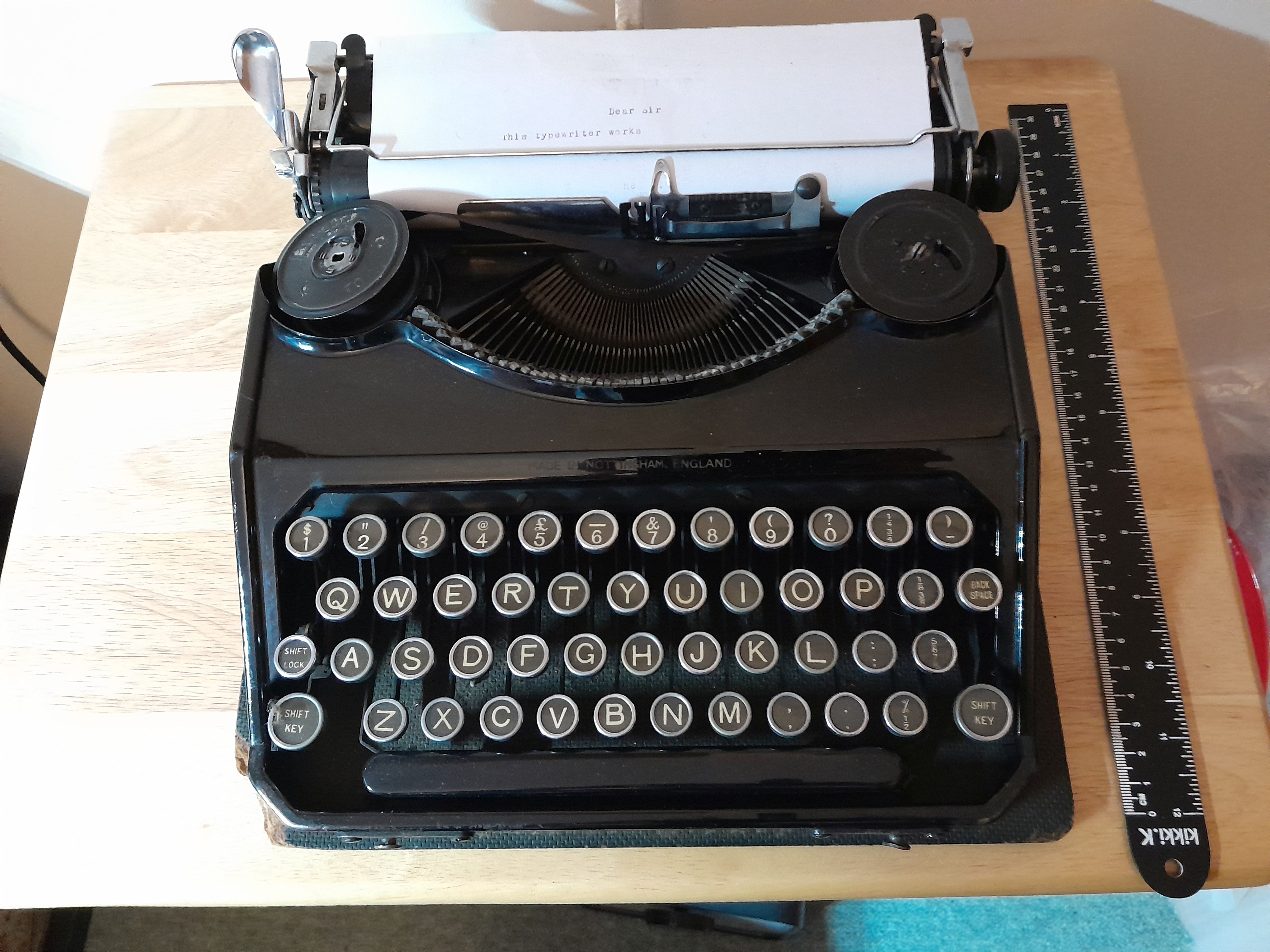
BAR – LOCK TYPEWRITER. Made in Nottingham, England. Model No. 6719. 1939 model. Very popular and up market small portable typewriter with hard case.
As competition between manufacturers grew the company was eventually bought out. This model was one of the last run made in 1939. It has 4 banks but with unusual 12 keys on top bank instead of usual 10.
It was one of the glossy black painted models as opposed to the matt black ones. It is missing the spool caps but otherwise in very good condition.
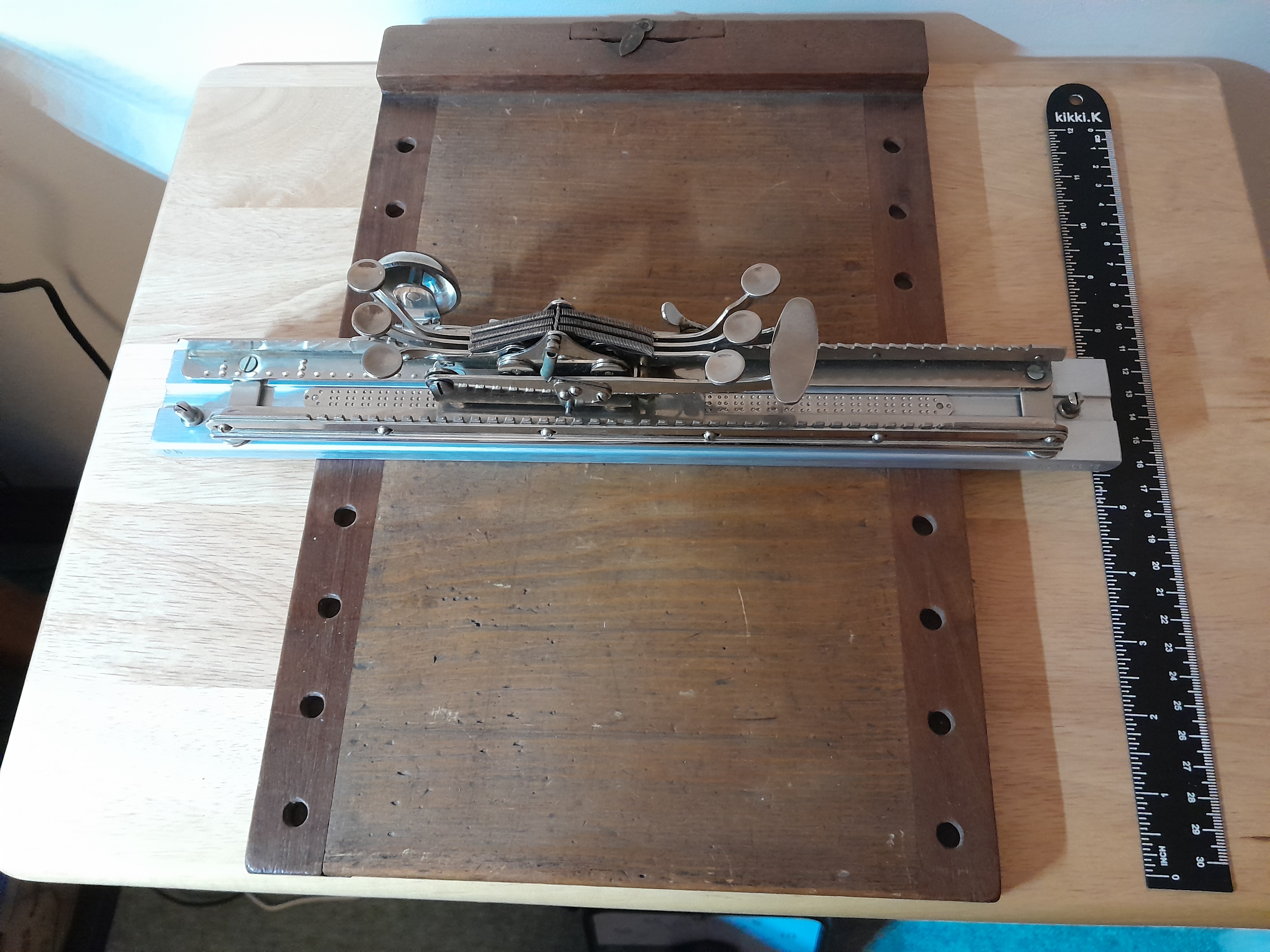
1930s Stainsby Wayne Braille writer. Made by V.L.Martin and Co Ltd, Southall, Mddx. For Royal National Institute for the Blind, London, W1. Model no M6673.
Works similar to an ordinary typewriter with the carriage travelling along the rails and the bell ringing at the carriage stop. However it only has 6 keys that by depressing individually or some
together will produce the whole 26 letters of the alphabet and more. Unlike a typewriter where you start at the left hand margin and type; here you start at the right and everything seems backwards until you pull the paper
out and turn it over.
Then you read from the left using your fingers to read the impressions made in the paper
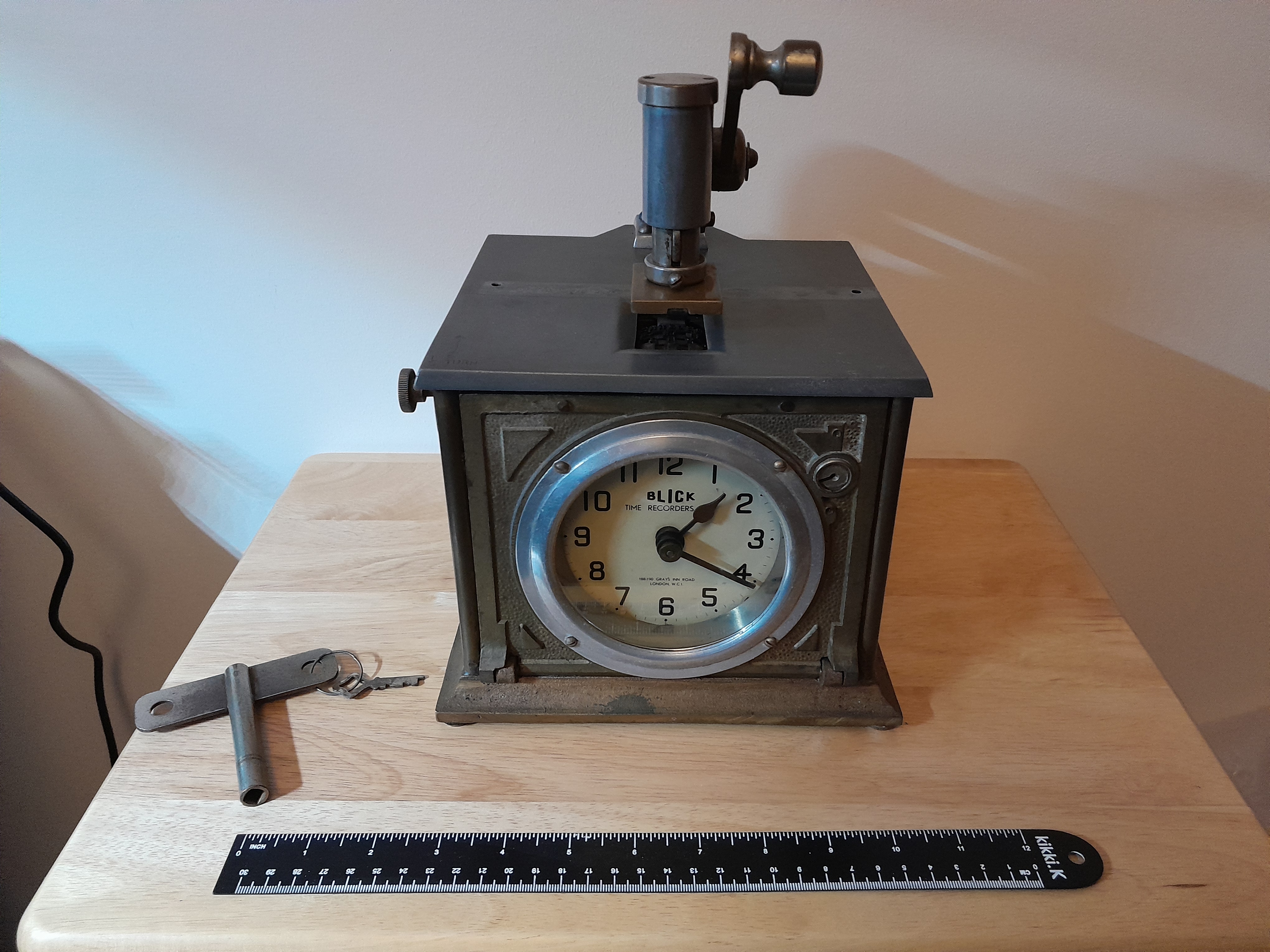
This is just a fun piece of equipment. It is a Blick Time recorder used for clocking in and out in factories, offices etc. Probably 1940s to 1950s. The clock is a 7 day heavy duty movement and is wound up with a large key at
the back. The front is lockable so that no one can tamper with the time recording mechanism.
The employee's time card is placed on top of the clock and the lever pressed fully down on it, thus recording the time and date on it.
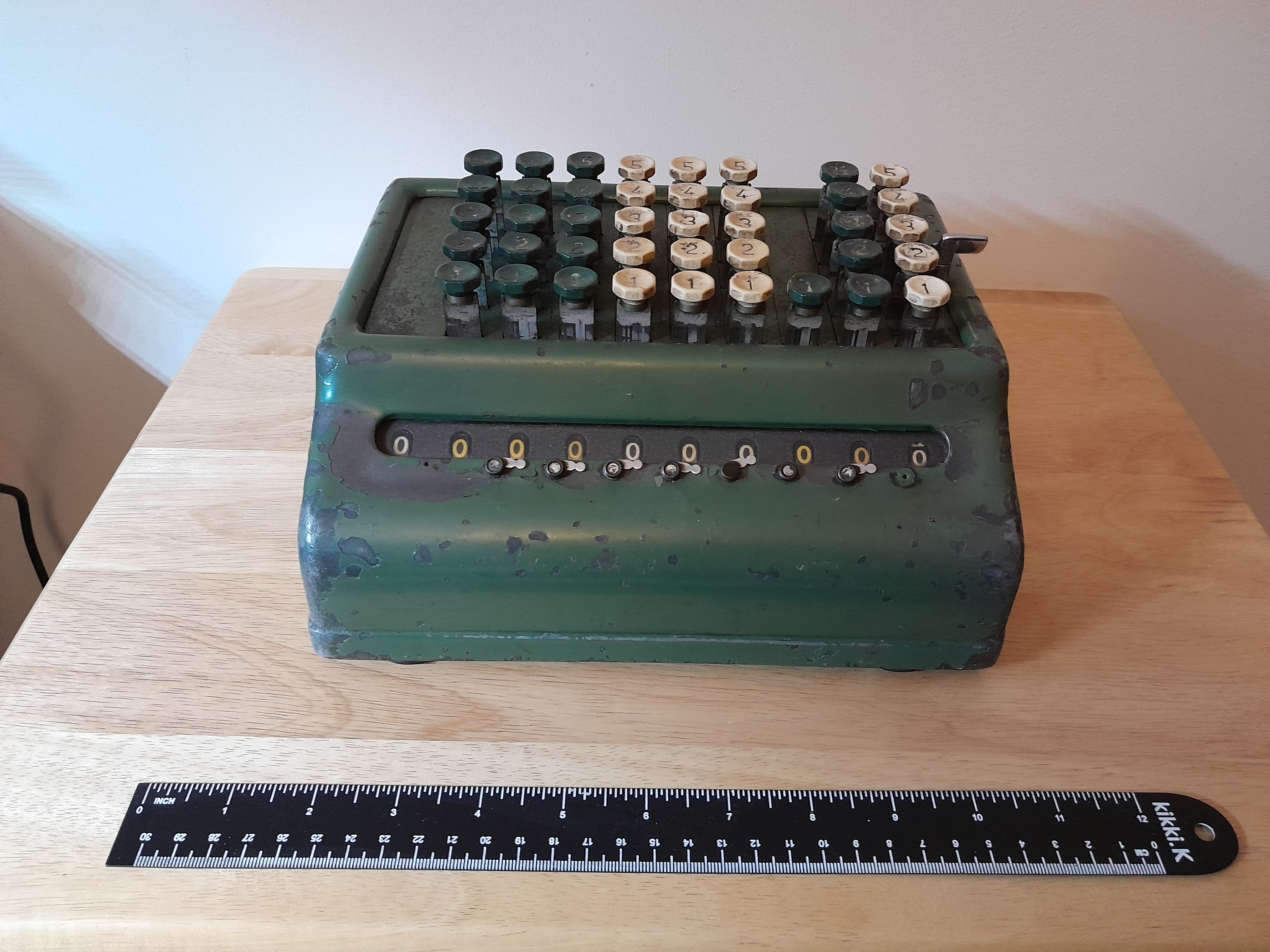
BELL PUNCH ADDING MACHINE. Plus model - Sterling model 509/S/61457. Bell Punch - distributed by London Computator Ltd. Year 1930s. This old adding machine is for the pre decimal system of pounds; shillings and pence.
It has 6 rows of pound buttons and provision for a total answer of 7 figures to provide a final answer of £9,999,999 and 19 shillings and 11 pence. In common with all the comptometers that I show here, or adding machines as
they are better known as, is that they all have half a keyboard that allows only the keys of 1 to 5 to be entered. If you want to enter a figure greater than 5, say 8, then you can press any combination you like, eg 6+2, 5+3,
4+4. There is no memory so that if a mistake is made, or your concentration is interrupted, then you have to start all over again. To reset to nil the lever on the right is pushed.
The machine is very heavy.
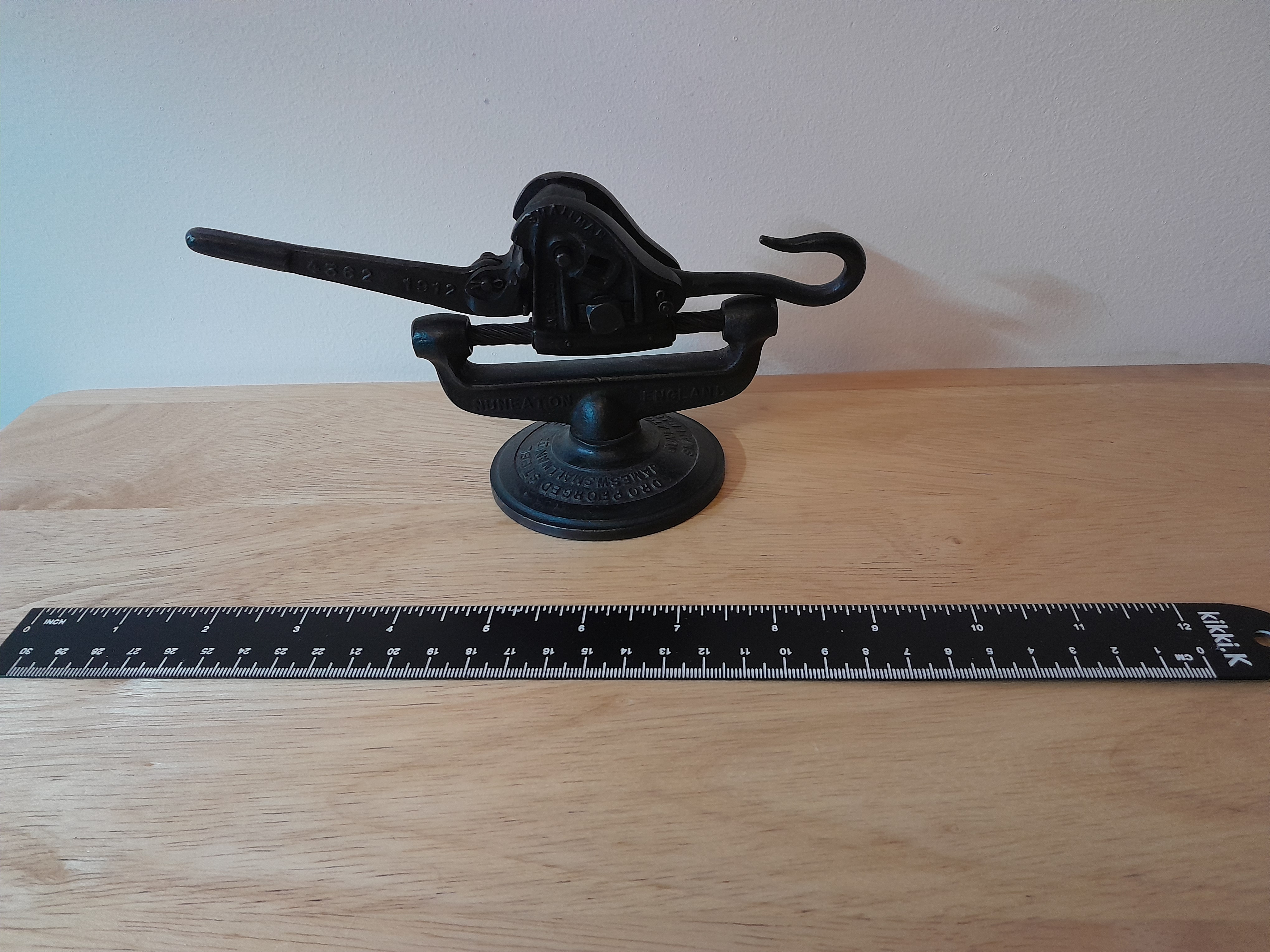
This is a Smallman safety clip. It is a salesman's sample that he would carry in his case when visiting all mines, both coal and mineral mines, all over the world. It is a working model to demonstrate the
much larger device that would be bought. It was invented by James Smallman of Nuneaton between 1893 and 1912. At the time coal was moved around the mines in buckets, similar to ski lifts and cable cars today, along a connecting wire cable. Previously crushed limbs and fingers were a frequent casualty when attaching and detaching the buckets.
This simple quick locking and unlocking device stopped the accidents and was more secure.
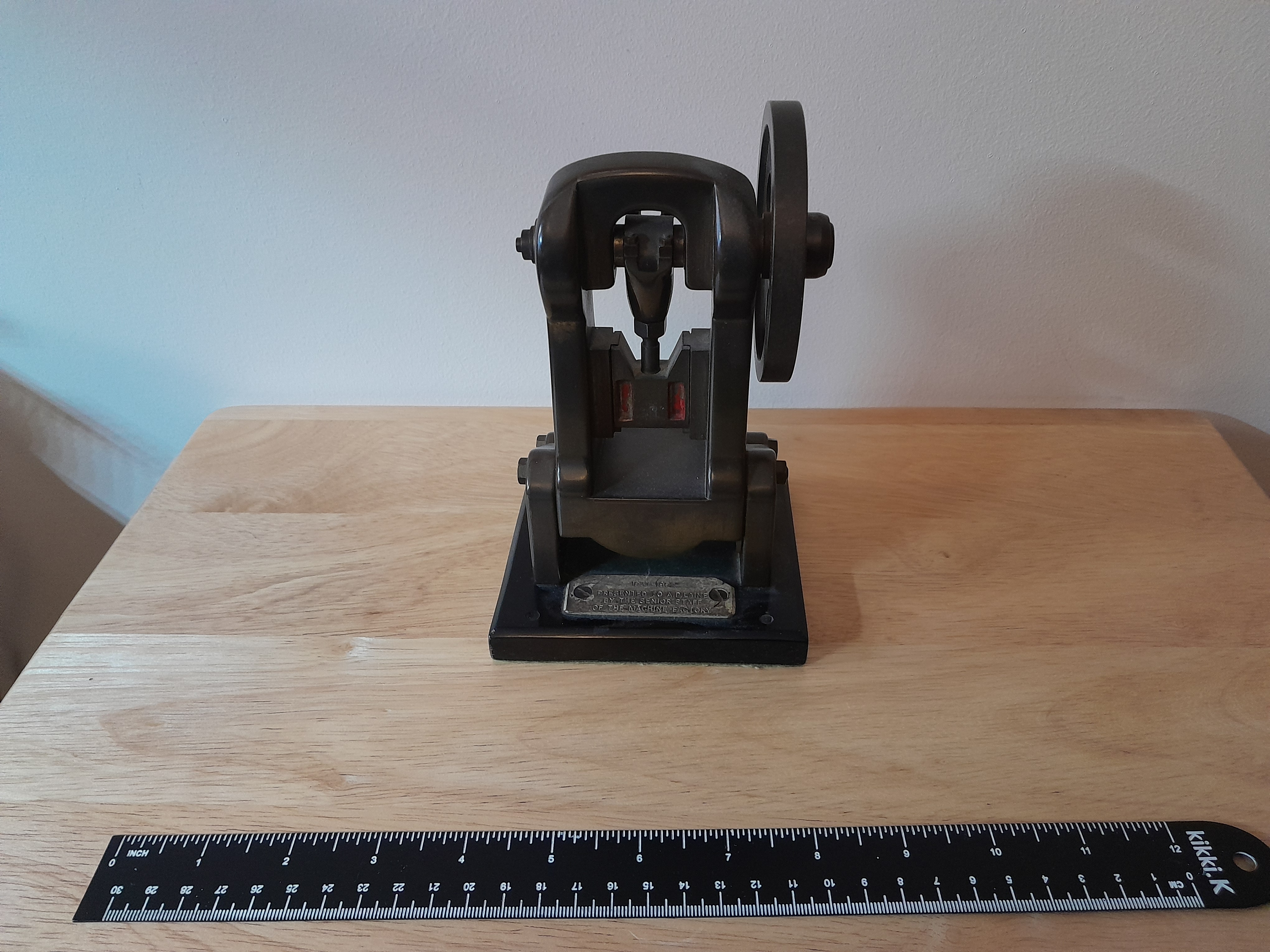
I saw this retirement gift on eBay and felt sorry that no one cared for it anymore. It is inscribed '1937-1962. Presented to A.P.Laine by the Senior Staff of the Machine Factory'.
It looks like a cleverly made and engineered working model of some giant heavy industrial stamping machine. Perhaps he had worked such a machine for 25 years and this was his reward.