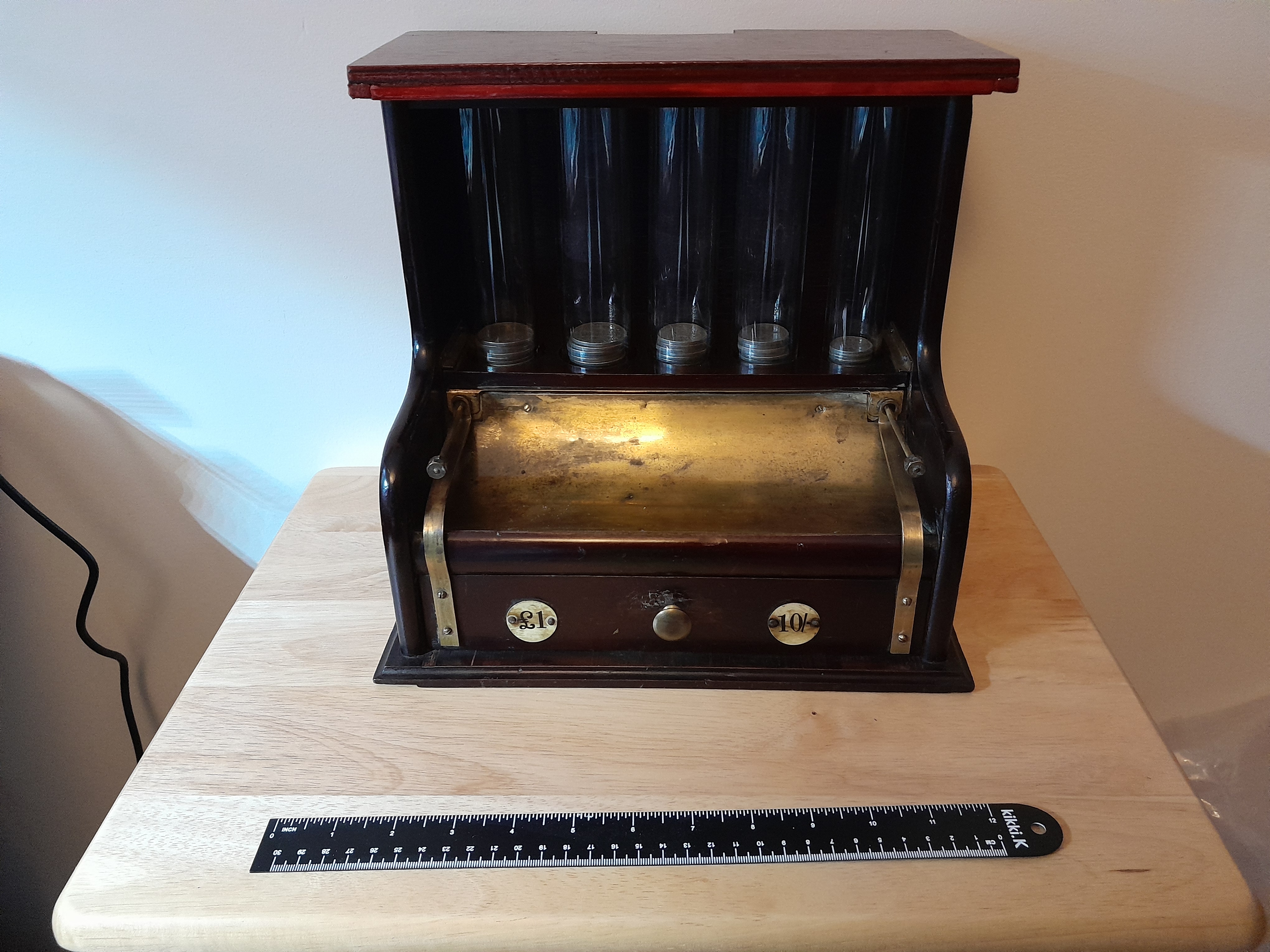
1910 'Quicktil' Patent No. 266,886,26
Manufacturers - Gaskell & Chambers; Bar Fitters; 109 -115 Blackfriars Road, London SE1 or W.R.Loftus Ltd. 18 Tottenham Court Road, London W1
This little change machine is an example of a simple idea of a useful item for a pub etc or a bank. If it had provision for it to be locked with a key then it would have been for a pub, if not lockable then it would have been for a bank.
The glass tubes from left to right would have been tubes 1 and 2 for half crowns (2/6), tubes 3 and 4 for florins (2/-) and tube 5 for shillings (1/-). One pull of the drawer handle released one coin from each tube thus dropping ten shillings (10/-) into the brass tray and the 10/- note offered would be placed in the drawer. Pull the drawer twice for a £1 note. The concealed bell rang each time the drawer was opened to alert that it was being used.
When I worked in a bank in 1960 we had one. They are quiet hard to come by now and are often in poor condition with the glass tubes either missing or broken. When I acquired this one all the glass tubes were perfect but the lid missing, hence why the lid is so obviously home made.
This little change machine is an example of a simple idea of a useful item for a pub etc or a bank. If it had provision for it to be locked with a key then it would have been for a pub, if not lockable then it would have been for a bank.
The glass tubes from left to right would have been tubes 1 and 2 for half crowns (2/6), tubes 3 and 4 for florins (2/-) and tube 5 for shillings (1/-). One pull of the drawer handle released one coin from each tube thus dropping ten shillings (10/-) into the brass tray and the 10/- note offered would be placed in the drawer. Pull the drawer twice for a £1 note. The concealed bell rang each time the drawer was opened to alert that it was being used.
When I worked in a bank in 1960 we had one. They are quiet hard to come by now and are often in poor condition with the glass tubes either missing or broken. When I acquired this one all the glass tubes were perfect but the lid missing, hence why the lid is so obviously home made.
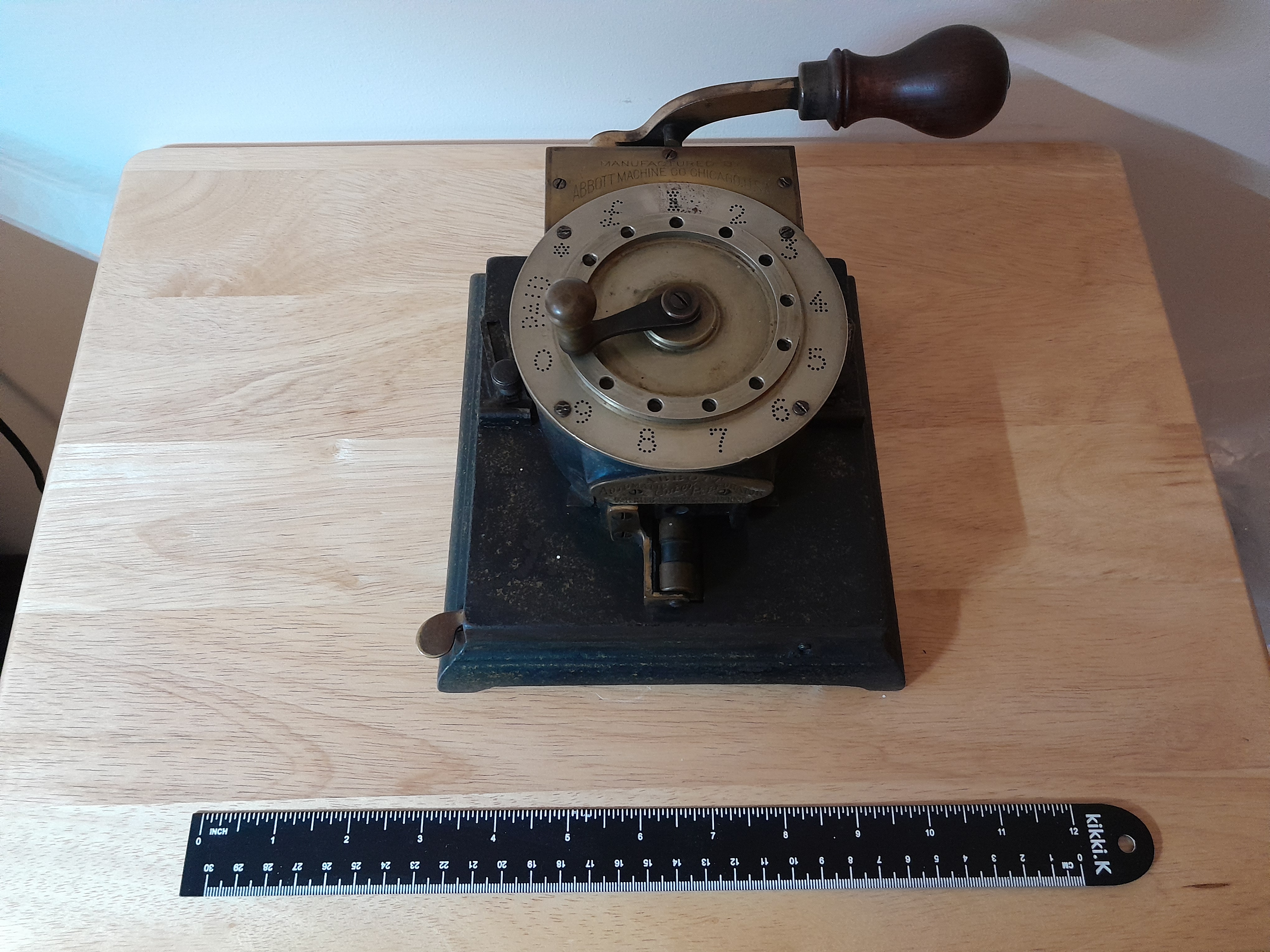
Here is a rare antique Abbotts brass and cast iron cheque perforator of about 1890. This one was made for the UK banks and a cheque would be inserted into the machine. By selecting a number on the dial and pressing the handle the number would be perforated onto the cheque and move on one space. This allowed for the full amount to be perforated onto the cheque thus eliminating any attempt
to fraudulently alter the amount.
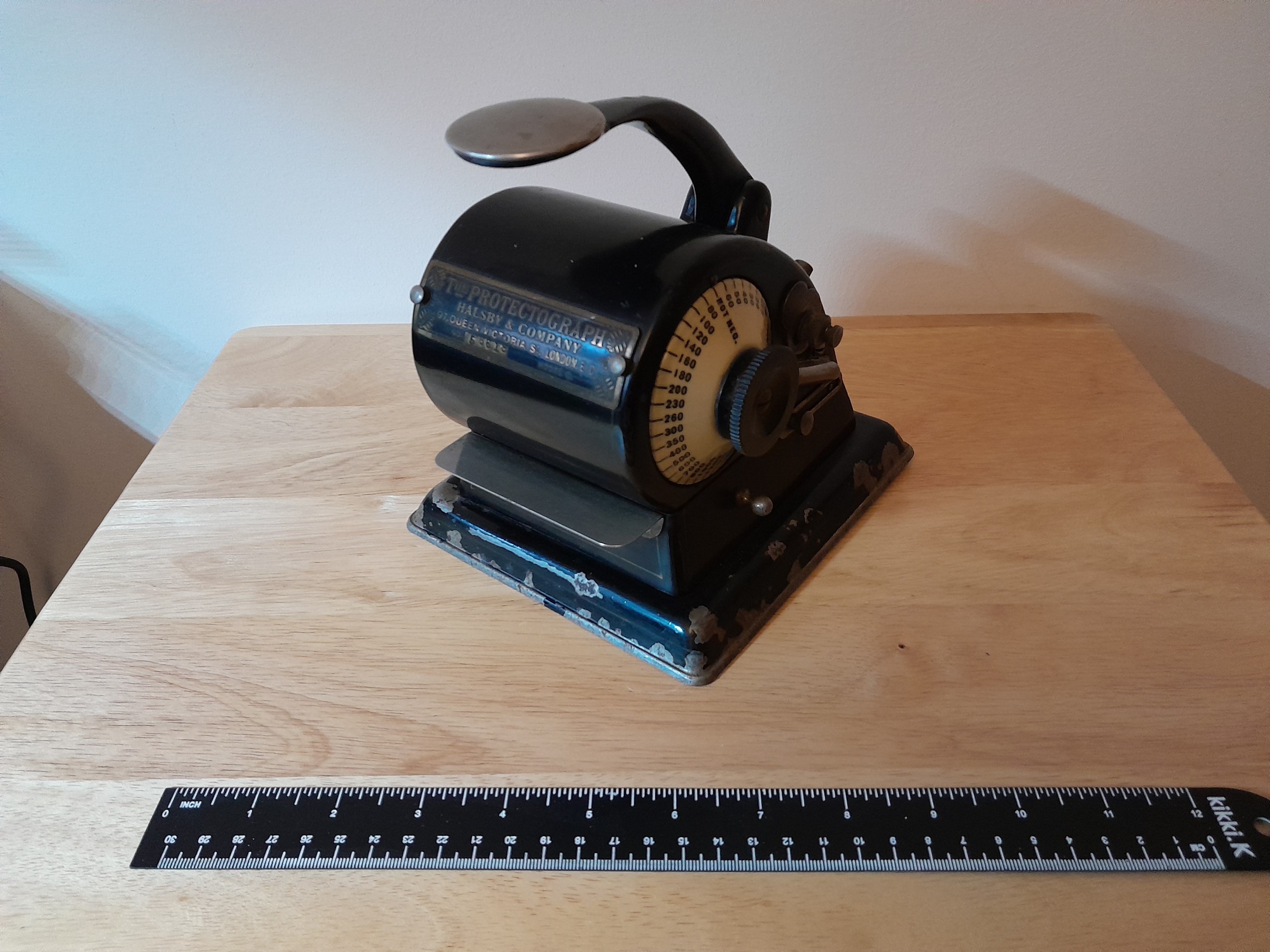
This is a cheque protectograph which is a machine to prevent fraudulent alteration of bank cheques. The cheque is inserted into the device; the dial is turned to a figure just over the amount that the cheque is written for and the lever pressed down. The result is that the cheque now carries an indelible embossed message stating that the value of the cheque is no more that the figure that the dial was turned to.
It is a G.W.Todd & Co model, approx 1915 - 1920,
manufactured by Halsby & Co; 87 Queen Victoria Street, London EC, under license,
Serial No. 56618 Model G
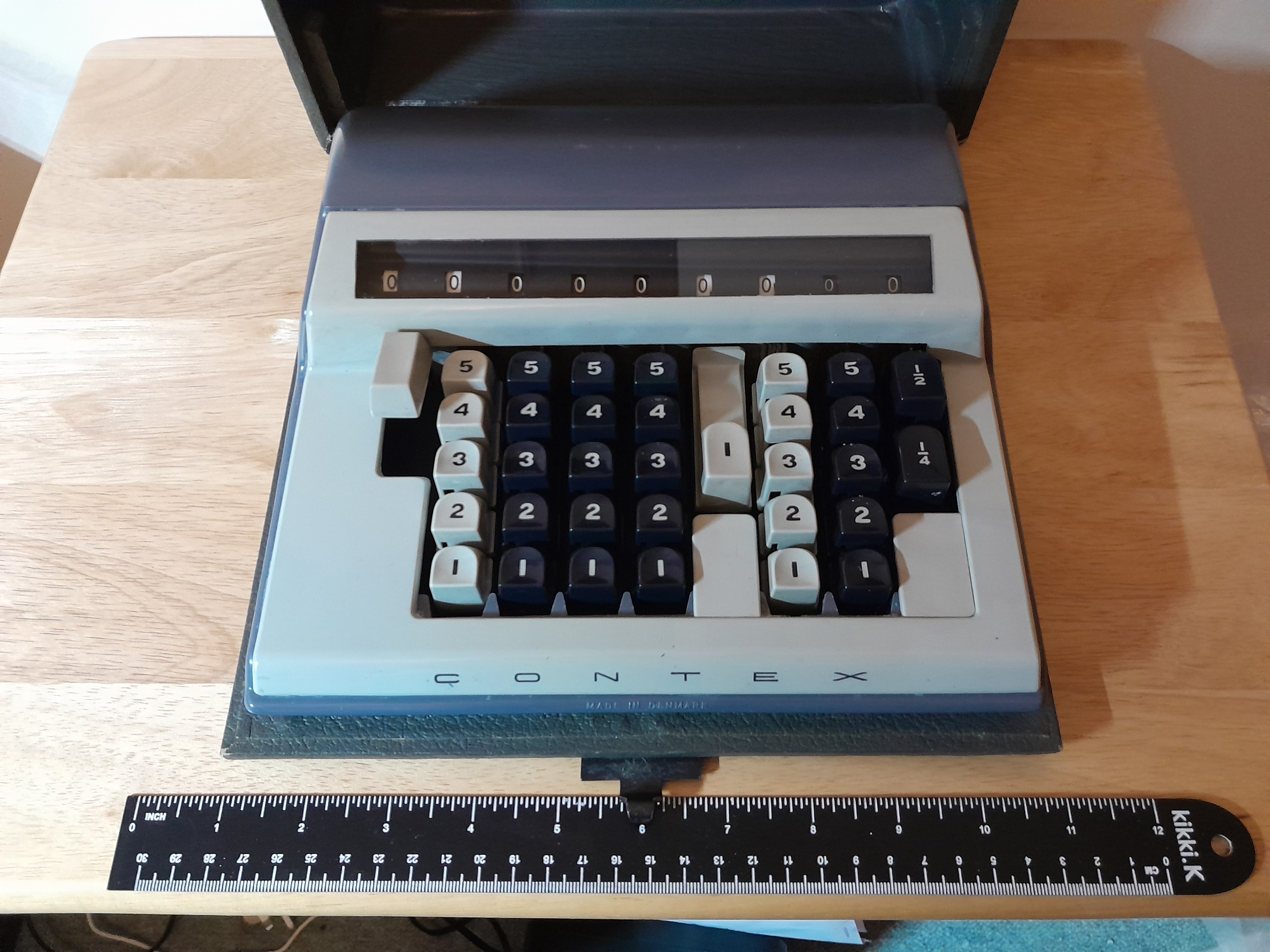
CONTEX ADDING MACHINE. Made in Denmark. Serial number 239367. Series s/1 . Year approx early 1950s. This old adding machine is for the pre decimal system of pounds; shillings and pence and farthings.
It has 4 rows of pound buttons and provision for a total answer of 5 figures to provide a final answer of £99,999 and 19 shillings and 11 pence and 3 farthings. In common with all the comptometers that I show here,
or adding machines as they are better known as, is that they all have half a keyboard that allows only the keys of 1 to 5 to be entered. If you want to enter a figure greater than 5, say 8, then you can press any combination
you like, eg 6+2, 5+3, 4+4. There is no memory so that if a mistake is made, or your concentration is interrupted, then you have to start all over again. To reset to nil the lever on the left is pushed.
The machine is made of plastic and therefore very light and comes with its own solid travelling case. Farthings as legal tender were abolished in 1960.
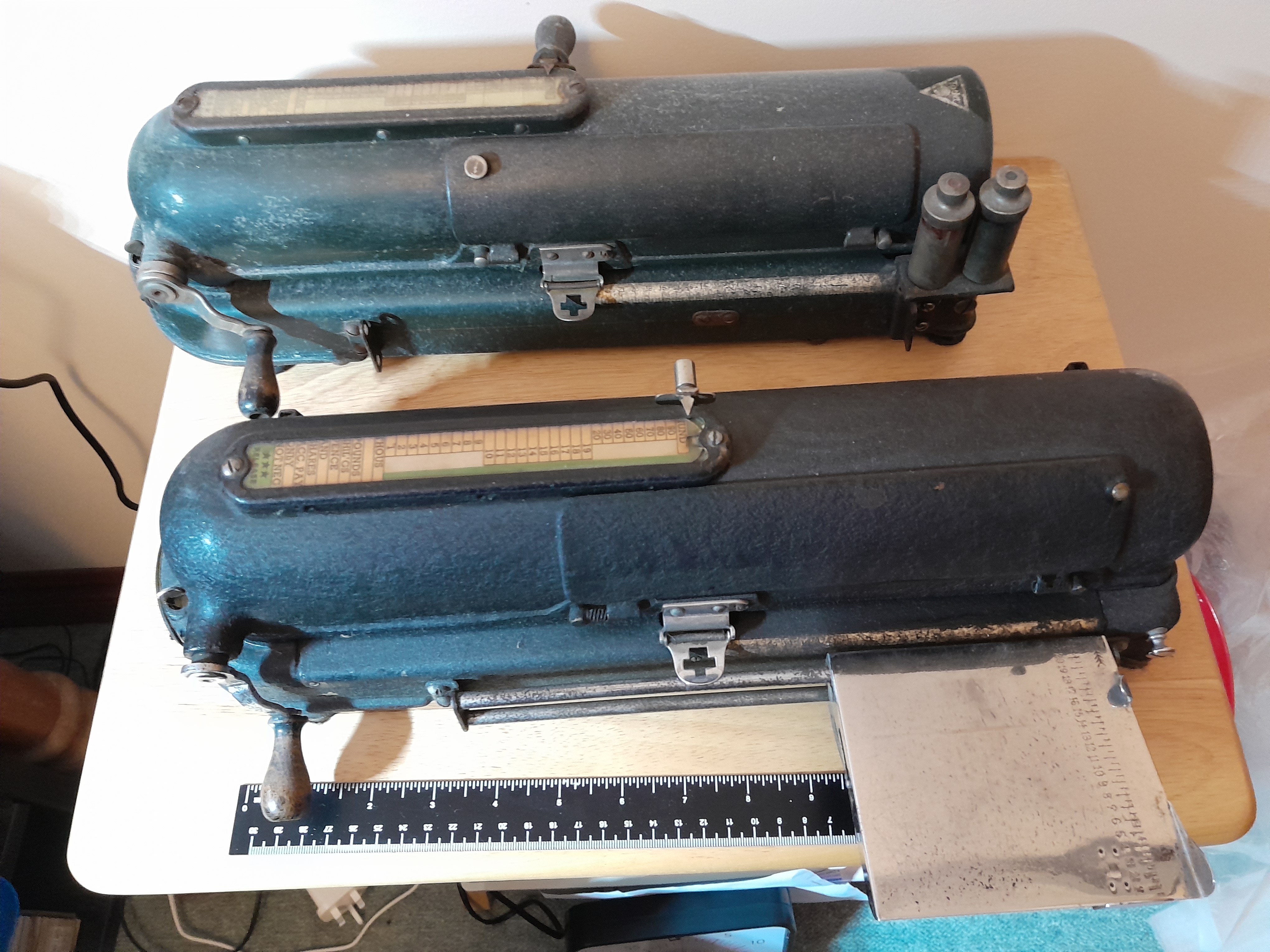
These two cheque protectographs machines are to prevent fraudulent alteration of bank cheques. The cheque is inserted into the device; the lever is turned to the first figure that the cheque is written for and
the handle on the left is turned a complete revolution. The result is that the cheque now carries an indelible same figure and moves on one space. This is repeated for each figure; £ sign, decimal point plus other options.
The cheque now carries the exact same amount as is written in words and figures.
It is a G.W.Todd & Co model, approx 1915 - 1920, manufactured by
Halsby & Co; 4 St Brides Street, London EC4, under license.
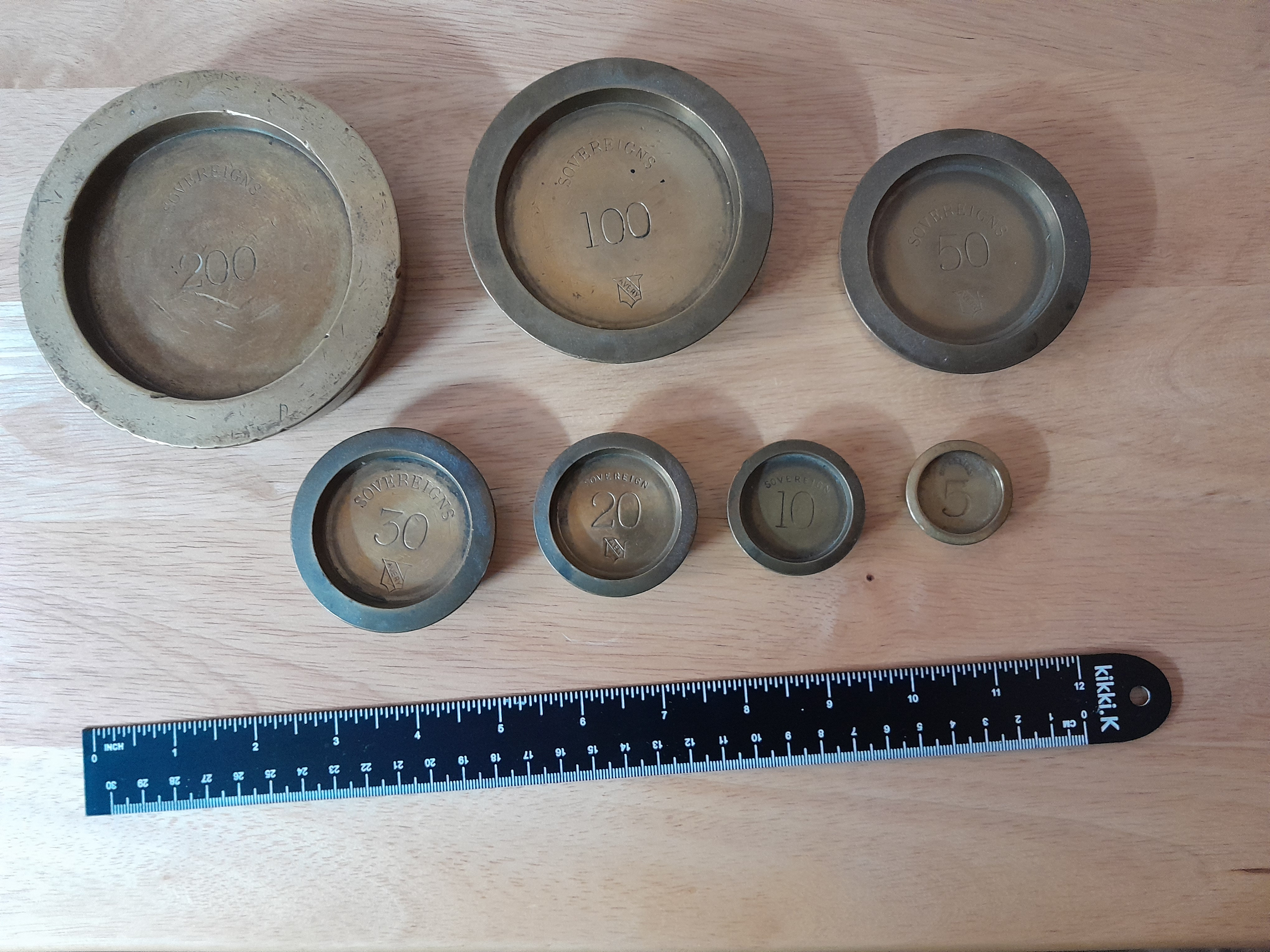
This set of gold sovereign weights is incomplete and probably dates from the 1890s. I am missing the 3; 2 and 1 sovereign weight. These brass weights were used in the UK from 1817 until around the early 1900s,
with their use beginning shortly after the new gold sovereign coin was introduced in 1817 as part of the Great Recoinage. They were used by banks and merchants to verify the bulk weight of the coins which were
subject to the illegal practice of clipping and sweating thus removing a small amount of gold from each coin. By the time of the First World War they were replaced by the new £1 paper note. The sovereign remains
legal tender and the Bank of England will always give you a nice shiny new £1 coin in exchange for it; but because of the price of gold today and the rarity of the coin itself, it is worth much more. Image what 200
coins would be worth today.
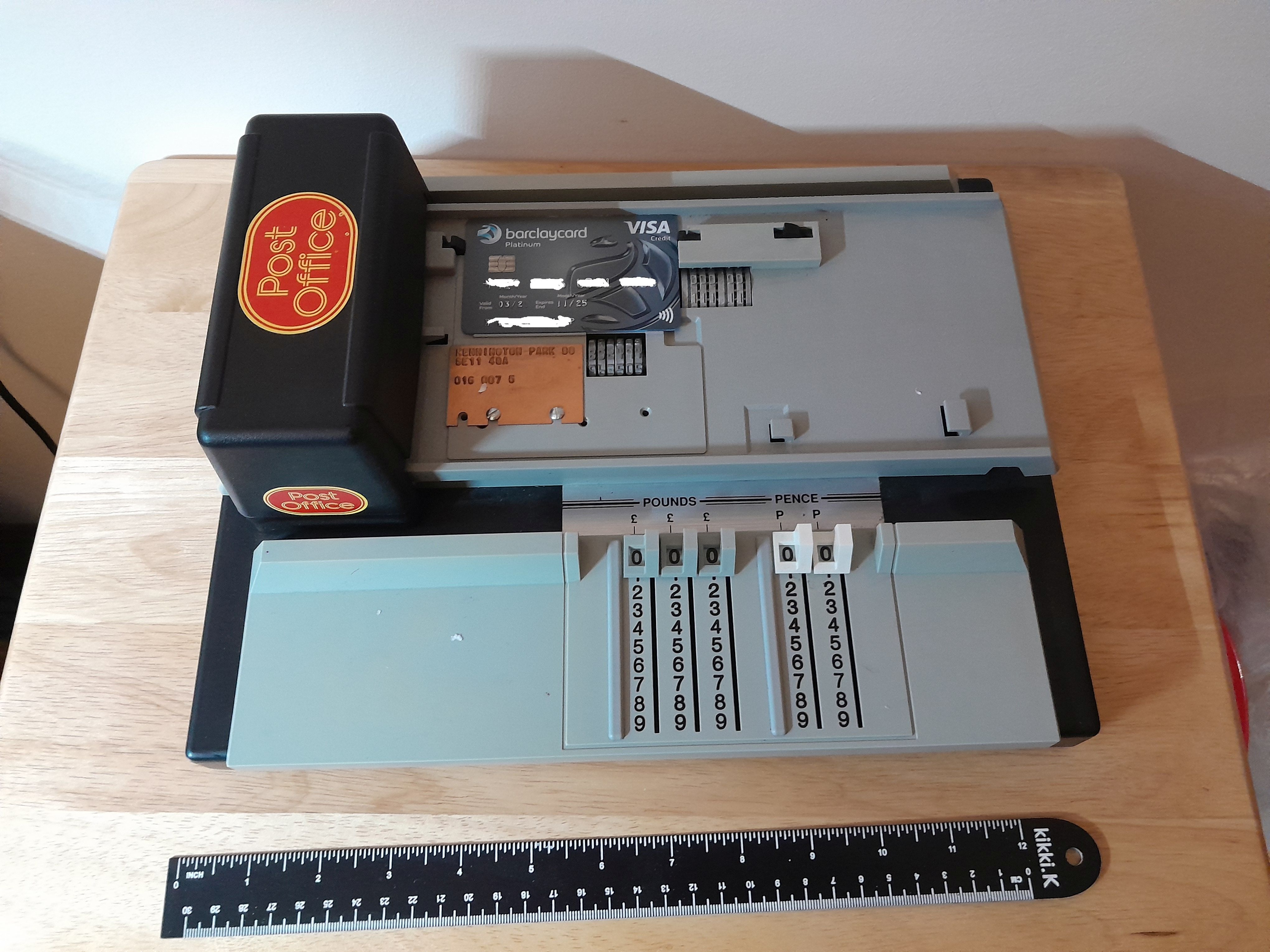
Royal Mail Post Office
Credit card imprinter. Model no. NBS Model 875 This type of credit card imprinter was very popular in the 1908s with banks, post offices and all shops etc. A self carbonating 3 page slip was completed at the point of sale, the credit placed in the machine as in the photo. Next the slip was placed over the card and the left hand side roller was moved to the right and the impression of the credit card and the sellers plate was transferred to the slip. In this instance the amount was included by using the levers below, otherwise it was written in by hand. The plate shows where this post office was - Kennington Park BO, SE11 40A, 016 007 5.
Credit card imprinter. Model no. NBS Model 875 This type of credit card imprinter was very popular in the 1908s with banks, post offices and all shops etc. A self carbonating 3 page slip was completed at the point of sale, the credit placed in the machine as in the photo. Next the slip was placed over the card and the left hand side roller was moved to the right and the impression of the credit card and the sellers plate was transferred to the slip. In this instance the amount was included by using the levers below, otherwise it was written in by hand. The plate shows where this post office was - Kennington Park BO, SE11 40A, 016 007 5.
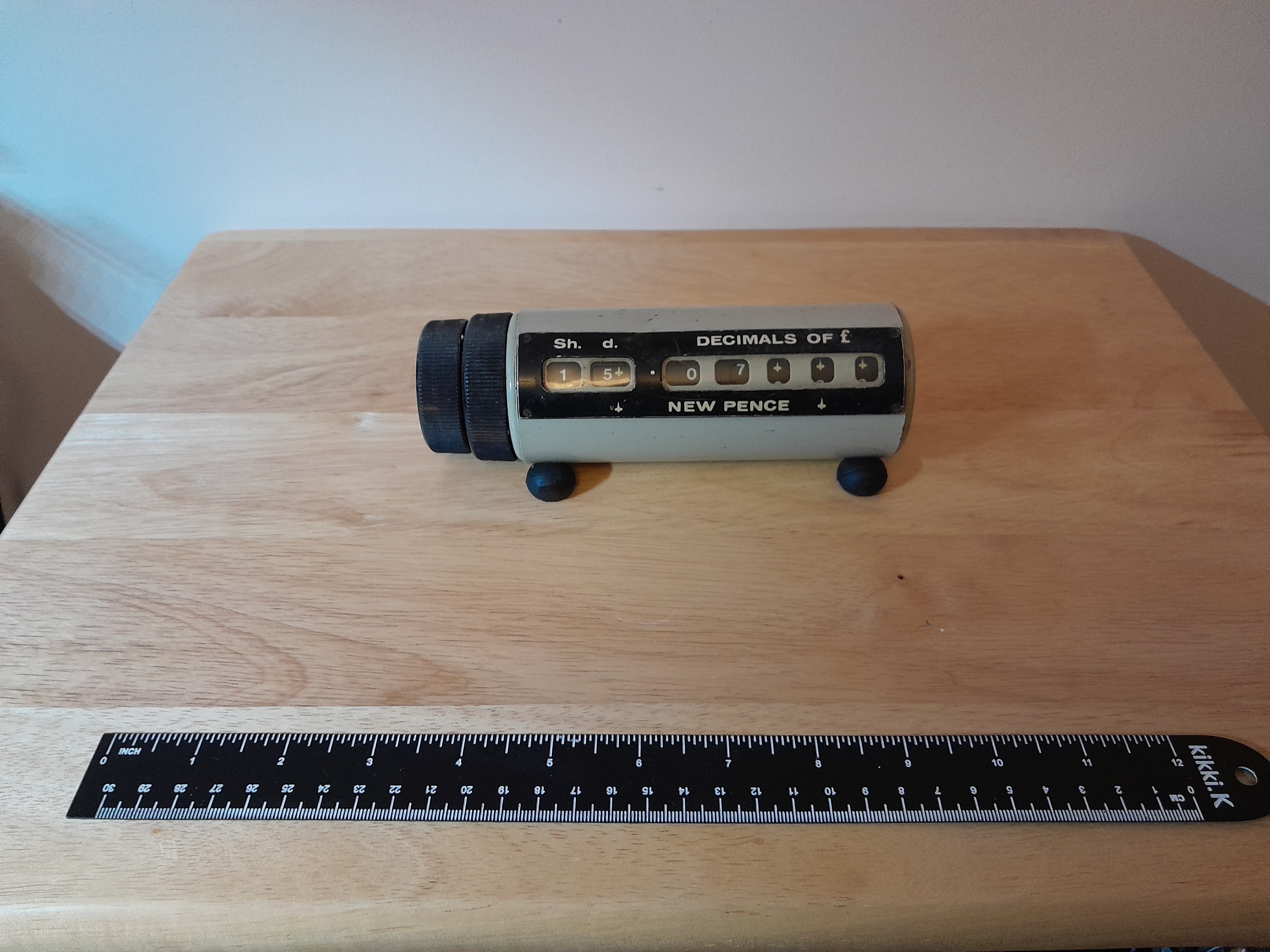
Decimalisation of UK currency.
The 1967 Decimalisation Act set the date of 1971 to change the shillings, pence and half pence coinage of the UK currency to a decimal part of a pound. The farthing had been decommissioned 10 years before. There were lots of printed paper and cardboard charts that set out an easy conversion. Then there were plastic gadgets with a few extra aspects that made it better than the free ones. However this converter was the top of the range and would have graced any office managerial desk. The first knob on the left controlled the shillings column, and the next controlled the pence. The photo shows it at 1 shilling and five pence halfpenny in the left hand side. The right hand side columns the automatically showed the answer as £07.000. I was working in a bank at the time and all balances were converted overnight. Some were rounded up and some were founded down. It was never clear who gained and who lost the odd halfpenny.
The 1967 Decimalisation Act set the date of 1971 to change the shillings, pence and half pence coinage of the UK currency to a decimal part of a pound. The farthing had been decommissioned 10 years before. There were lots of printed paper and cardboard charts that set out an easy conversion. Then there were plastic gadgets with a few extra aspects that made it better than the free ones. However this converter was the top of the range and would have graced any office managerial desk. The first knob on the left controlled the shillings column, and the next controlled the pence. The photo shows it at 1 shilling and five pence halfpenny in the left hand side. The right hand side columns the automatically showed the answer as £07.000. I was working in a bank at the time and all balances were converted overnight. Some were rounded up and some were founded down. It was never clear who gained and who lost the odd halfpenny.
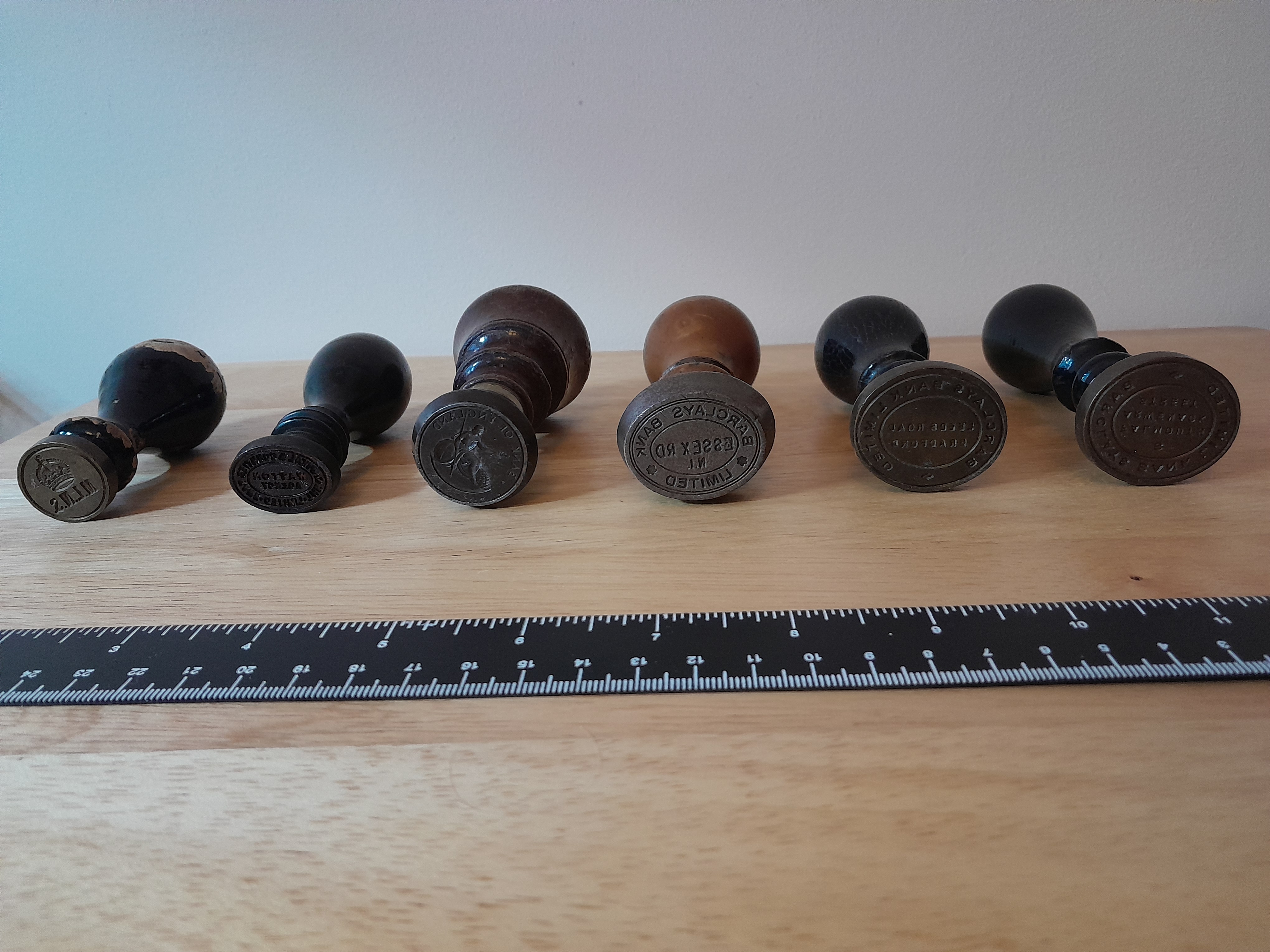
Sealing Wax Stamps.
Sealing wax stamps are symbols of authority and when placed on a document of importance has the same validity as if the document had been signed by the author. Sealing wax, normally red, would be melted by using a match, or similar, and allowed to drip and form a small puddle on the paper where the user wanted it. Then immediately the seal was placed firmly in the centre of the puddle, wait a few seconds, and then remove leaving a perfect mirror copy in wax of what the seal should be. These stamps would be kept under lock and key because in the wrong hands they could authenticate the document. When the seal was no longer required it should have been destroyed but these were not and appeared on eBay.
The first on the left is a 1940s official Ministry of Labour and National Service brass stamp with crown and initials M.L.N.S. Next is The Capital and Counties Bank Limited, Watton Branch, then Bank of England with Britannia, then 3 Barclays each with the branch, now closed. I worked for Barclays and used these stamps on a daily basis and also know that when the branch closed, they should have been destroyed.
The Capital and Counties Bank Ltd was formed in 1877 and taken over by Lloyds Bank in 1918. Watton is in Norfolk.
Sealing wax stamps are symbols of authority and when placed on a document of importance has the same validity as if the document had been signed by the author. Sealing wax, normally red, would be melted by using a match, or similar, and allowed to drip and form a small puddle on the paper where the user wanted it. Then immediately the seal was placed firmly in the centre of the puddle, wait a few seconds, and then remove leaving a perfect mirror copy in wax of what the seal should be. These stamps would be kept under lock and key because in the wrong hands they could authenticate the document. When the seal was no longer required it should have been destroyed but these were not and appeared on eBay.
The first on the left is a 1940s official Ministry of Labour and National Service brass stamp with crown and initials M.L.N.S. Next is The Capital and Counties Bank Limited, Watton Branch, then Bank of England with Britannia, then 3 Barclays each with the branch, now closed. I worked for Barclays and used these stamps on a daily basis and also know that when the branch closed, they should have been destroyed.
The Capital and Counties Bank Ltd was formed in 1877 and taken over by Lloyds Bank in 1918. Watton is in Norfolk.
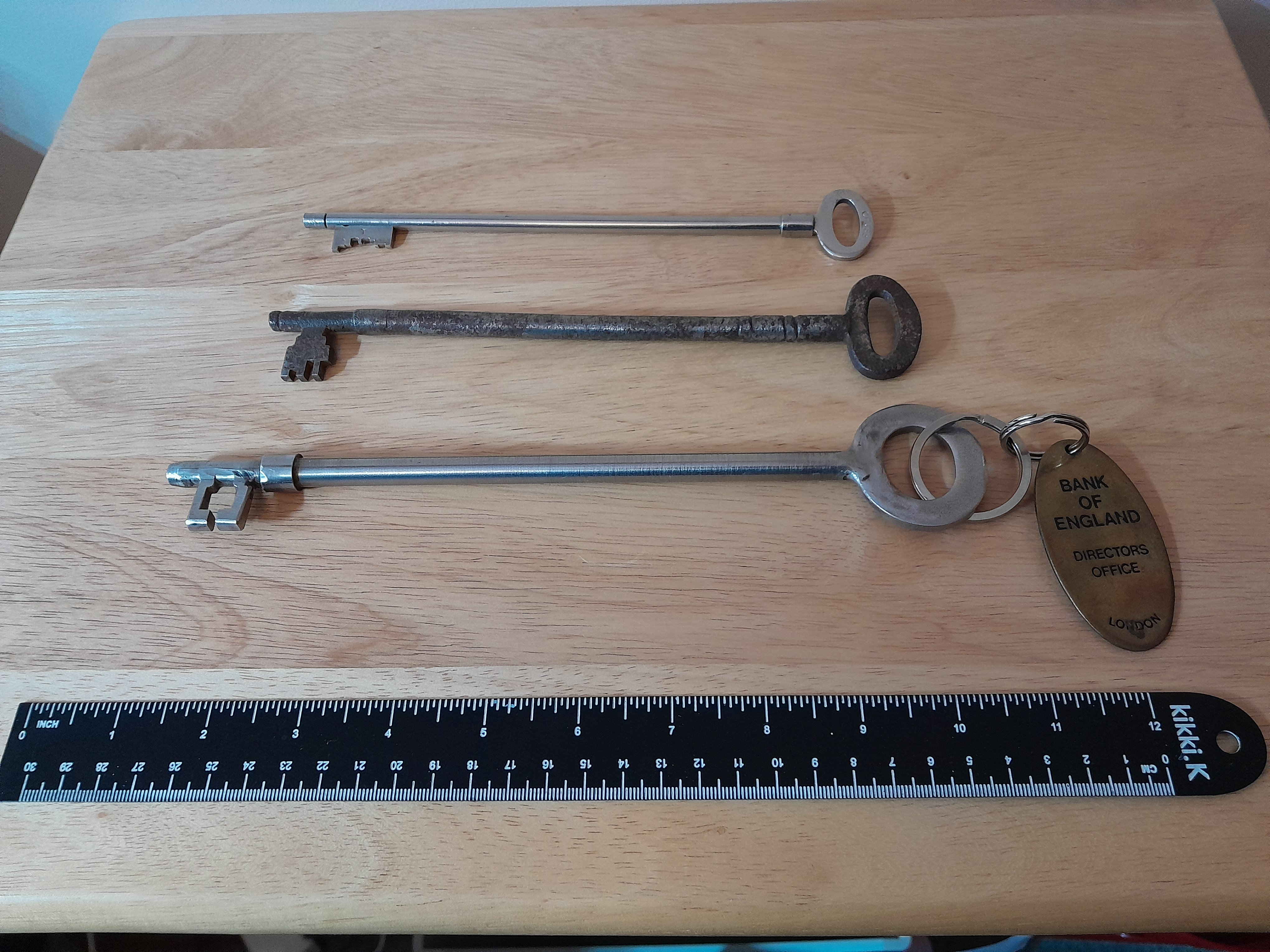
Three safe vault keys
You can see from the picture that these are very big. They are the type that we use to unlock the vaults when I worked in a bank. The bottom one gives an idea of the thickness of the door as it is half the width of the door. The key ring and tag are not genuine and are only there for fun. The top one allows for the unlocking part of the key to be removed after use. That allowed the keyholder to take only the small part with him leaving the stem behind.
You can see from the picture that these are very big. They are the type that we use to unlock the vaults when I worked in a bank. The bottom one gives an idea of the thickness of the door as it is half the width of the door. The key ring and tag are not genuine and are only there for fun. The top one allows for the unlocking part of the key to be removed after use. That allowed the keyholder to take only the small part with him leaving the stem behind.