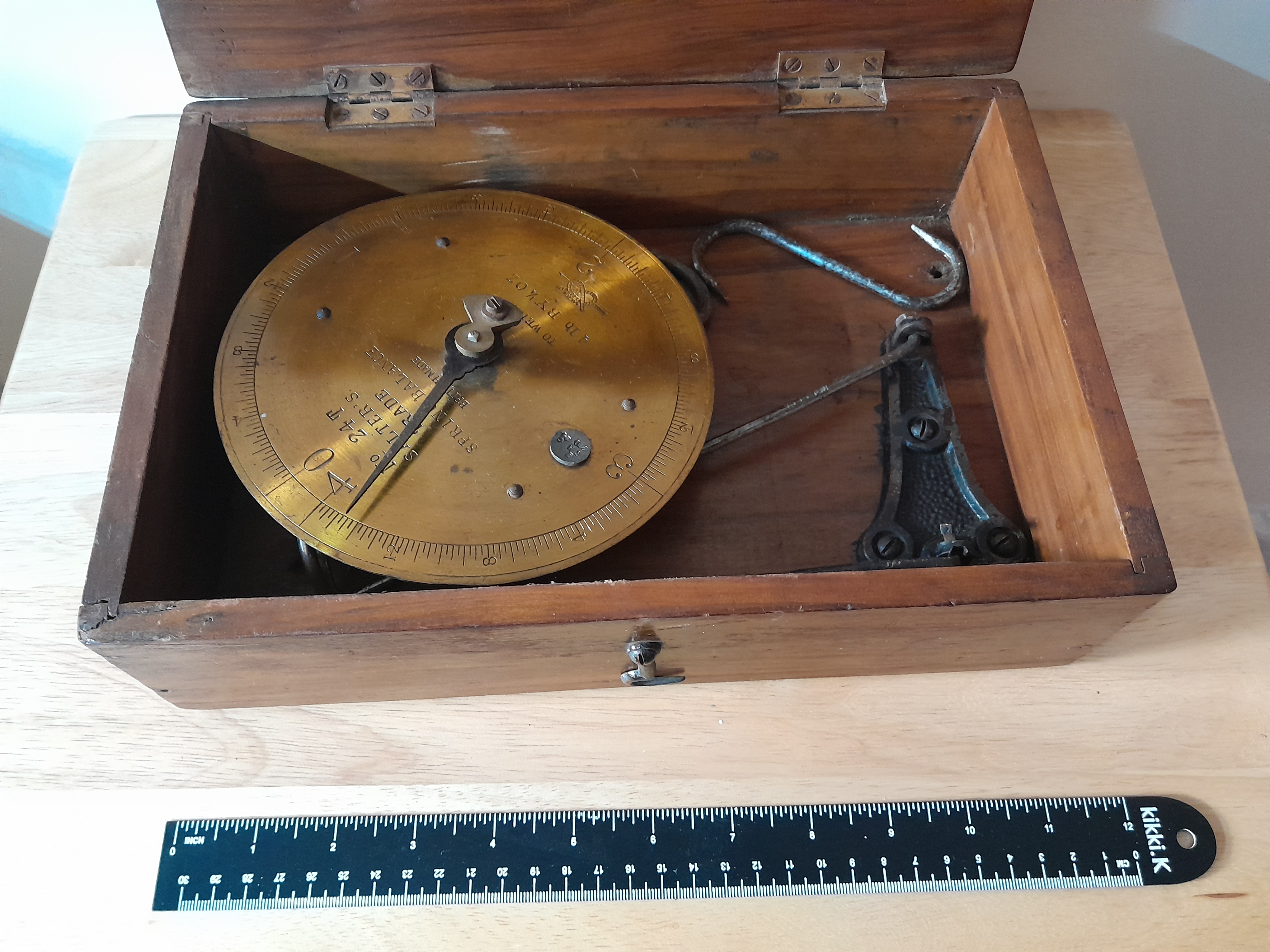
This is a set of travelling Salter scales as used by the travelling fruit and veg merchant when they called at your house. They collapse and sit nicely in
their wooden box and swing on their in built scaffold and swivel round so that it hangs outside the box in order that your purchases could be weighed.
Note that they bear the usual Weights and Measure lead seal as proof that the calibration and accuracy had recently been checked.
Note that they bear the usual Weights and Measure lead seal as proof that the calibration and accuracy had recently been checked.
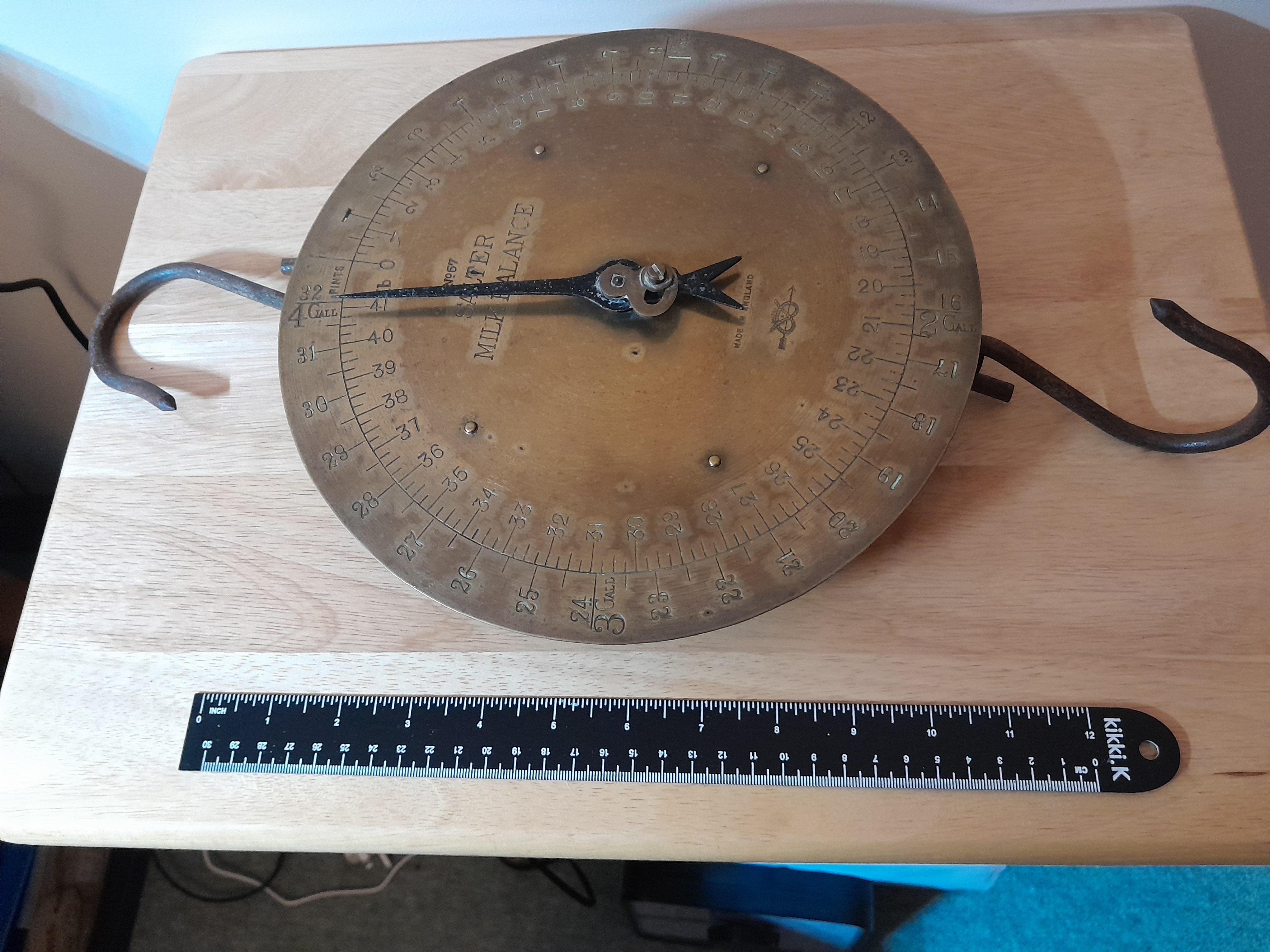
The nostalgia of country rural life is soon forgotten but I wonder how many retired dairy farmers remember using milk scales as seen in the photograph of one in my collection. When the farmer had hand milked direct
into a pail, he would then hang the bucket on the scale and record Daisy's efforts on her record chart. These scales are unusual as they register weight up to 41 lbs and volume in pints up to 4 gallons. They serve no other
purpose and were not for commercial use and therefore do not bear the usual Weights and Measure lead seal as proof that the calibration and accuracy had recently been checked.
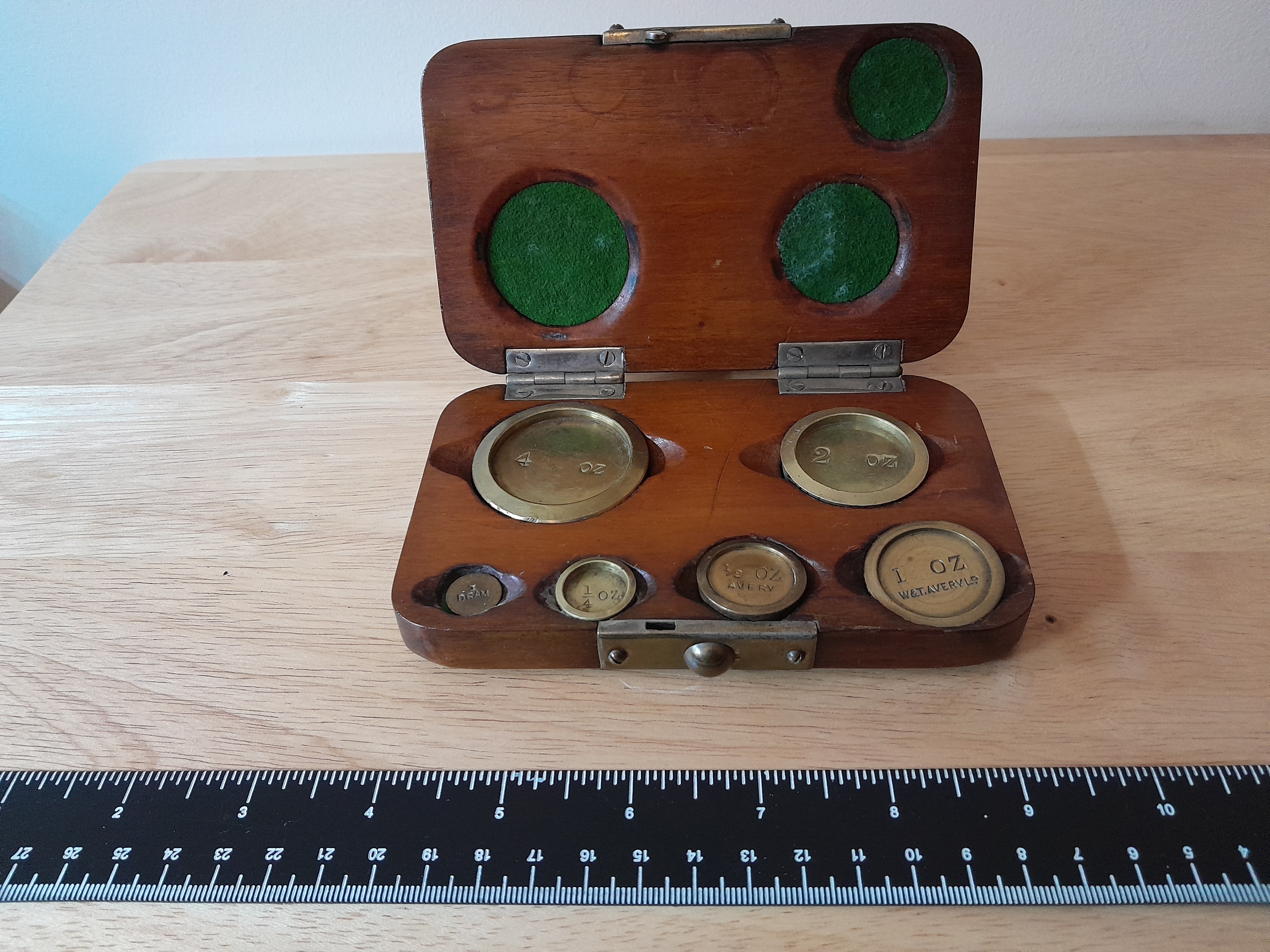
Boxed weights.
Not much can be said about this nice small box of weights. I just like the quality of the workmanship. The weights are made by Avery and are 4oz; 2oz; 1oz; half ounce; quarter ounce and 1 Dram. The dram is marked on the reverse 'GR 1 27037' which I assume was the usual Weights and Measure proof that the calibration and accuracy had recently been checked. There is a recess on all the other weights where the lead seal would have been. It is not uncommon for the lead to removed because of its value when the weights were no longer used.
Not much can be said about this nice small box of weights. I just like the quality of the workmanship. The weights are made by Avery and are 4oz; 2oz; 1oz; half ounce; quarter ounce and 1 Dram. The dram is marked on the reverse 'GR 1 27037' which I assume was the usual Weights and Measure proof that the calibration and accuracy had recently been checked. There is a recess on all the other weights where the lead seal would have been. It is not uncommon for the lead to removed because of its value when the weights were no longer used.
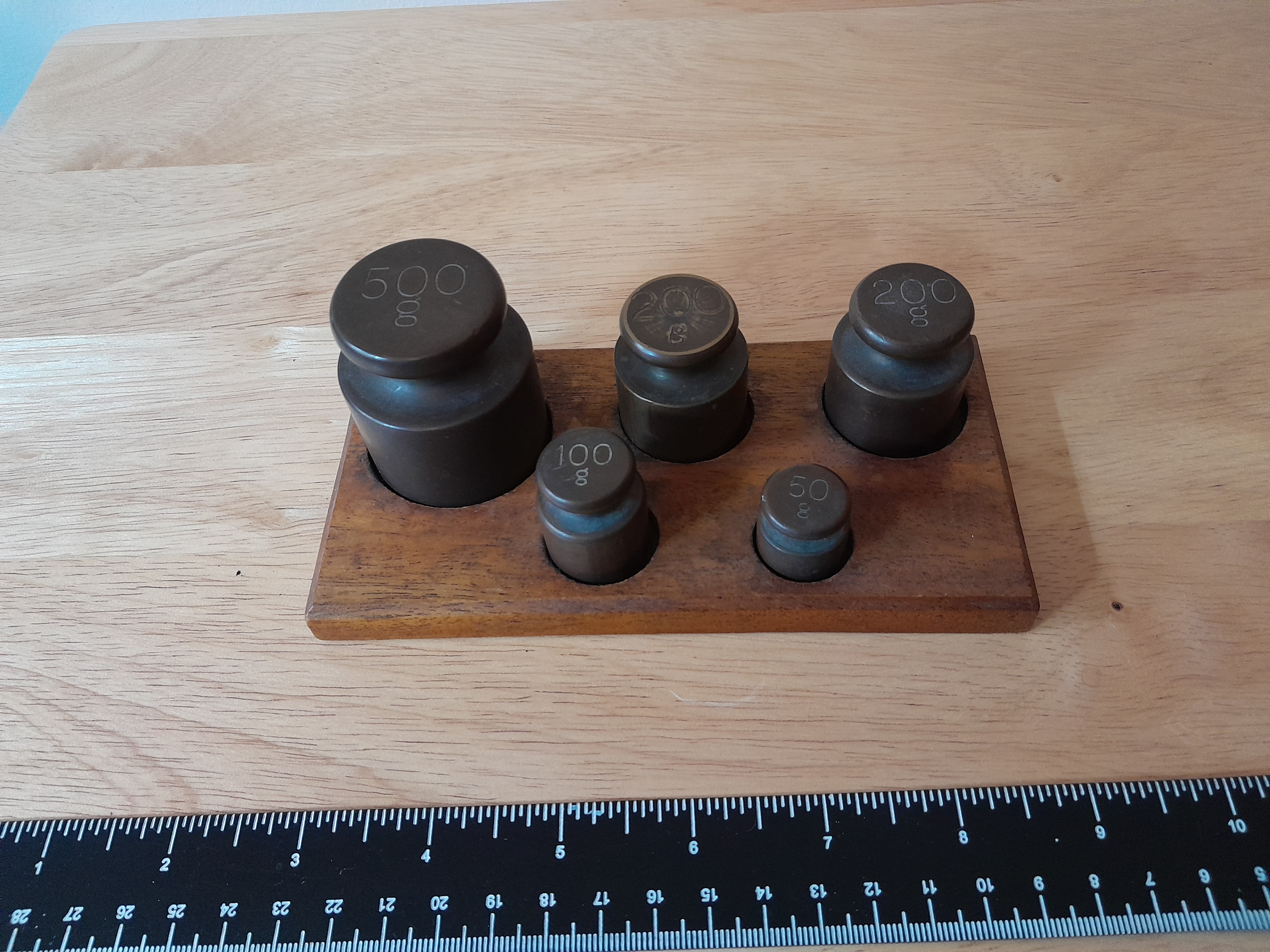
Unboxed weights
Just a set on metric weights.
Just a set on metric weights.
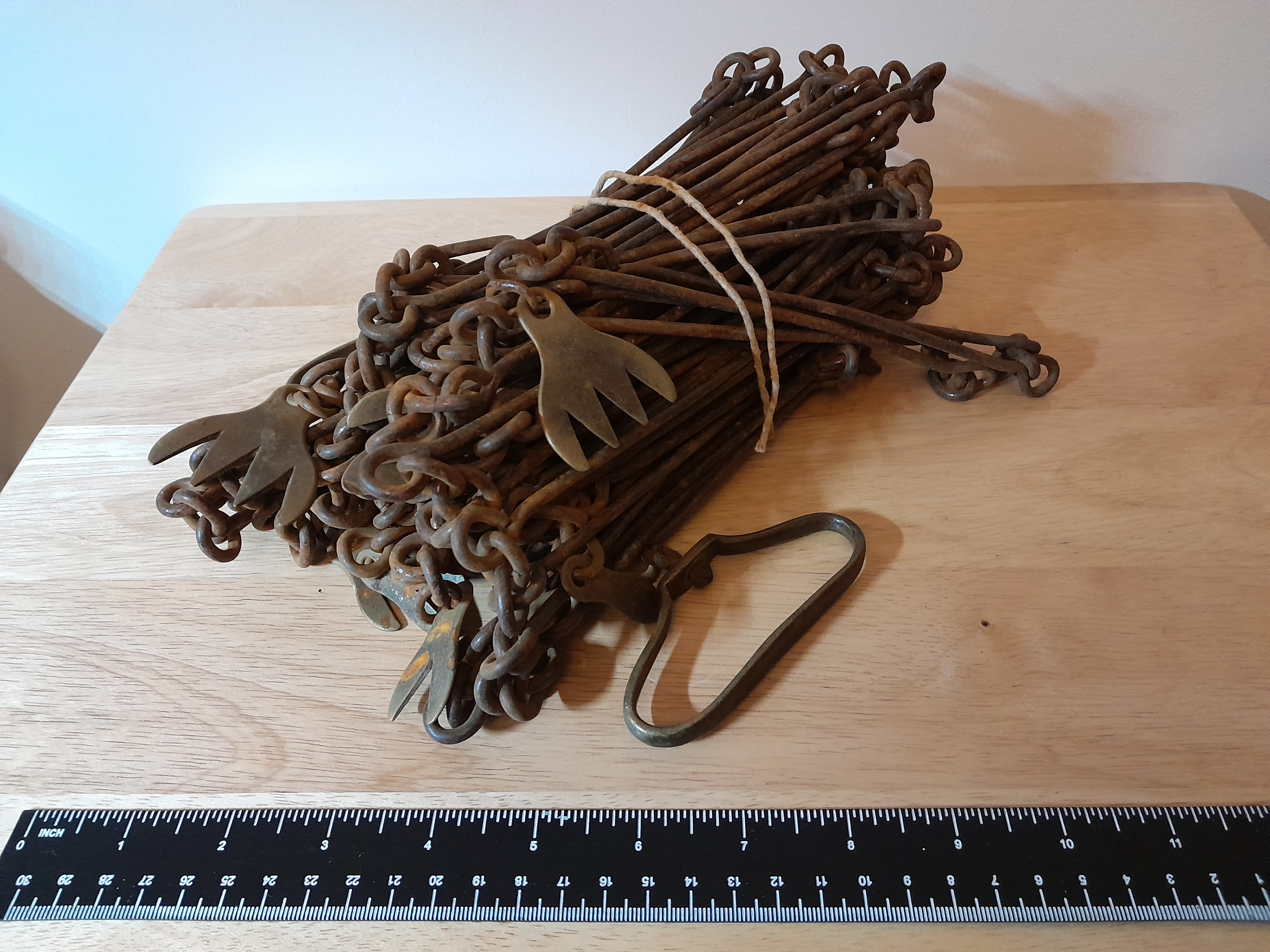
Gunter's chain.
Gunter's chain is a 66-foot (22-yard) long measuring chain with 100 links, developed by Edmund Gunter in 1620 for surveying and land measurement. It was a crucial tool for nearly 300 years, with brass tags marking every 10 links to simplify calculations, as 10 square chains equal one acre. Gunter's chain was the primary means of measuring land and was widely used across the British Empire, influencing city planning.The chain was eventually replaced by the steel tape in the late 19th century.
How it was used
2 brass handles, 9 brass tags one marked 'warranted correct' and 3 Swivel joints. Length: 66 feet (or 22 yards) Links: 100 links per chain. Link length: Each link is 7.92 inches long Tags: Brass tags are located at every 10th link, with the number of points on the tag indicating its position (e.g., 1 point for 10 links, 2 points for 20 links) Handles: A handle is located at each end of the chain
Applications and significance
The chain was used to measure the area of land plots. Its design simplified area calculations, as one acre is equal to 10 square chains. It was also used for other distance measurements; for example, a cricket pitch is one chain long. The two ends of the chain were held by two surveyors, who would stretch the chain out over the distance to be measured. The chain was designed to be pulled taut and held flat on the ground. The tags on the chain helped with counting and calculating distances.
Gunter's chain is a 66-foot (22-yard) long measuring chain with 100 links, developed by Edmund Gunter in 1620 for surveying and land measurement. It was a crucial tool for nearly 300 years, with brass tags marking every 10 links to simplify calculations, as 10 square chains equal one acre. Gunter's chain was the primary means of measuring land and was widely used across the British Empire, influencing city planning.The chain was eventually replaced by the steel tape in the late 19th century.
How it was used
2 brass handles, 9 brass tags one marked 'warranted correct' and 3 Swivel joints. Length: 66 feet (or 22 yards) Links: 100 links per chain. Link length: Each link is 7.92 inches long Tags: Brass tags are located at every 10th link, with the number of points on the tag indicating its position (e.g., 1 point for 10 links, 2 points for 20 links) Handles: A handle is located at each end of the chain
Applications and significance
The chain was used to measure the area of land plots. Its design simplified area calculations, as one acre is equal to 10 square chains. It was also used for other distance measurements; for example, a cricket pitch is one chain long. The two ends of the chain were held by two surveyors, who would stretch the chain out over the distance to be measured. The chain was designed to be pulled taut and held flat on the ground. The tags on the chain helped with counting and calculating distances.
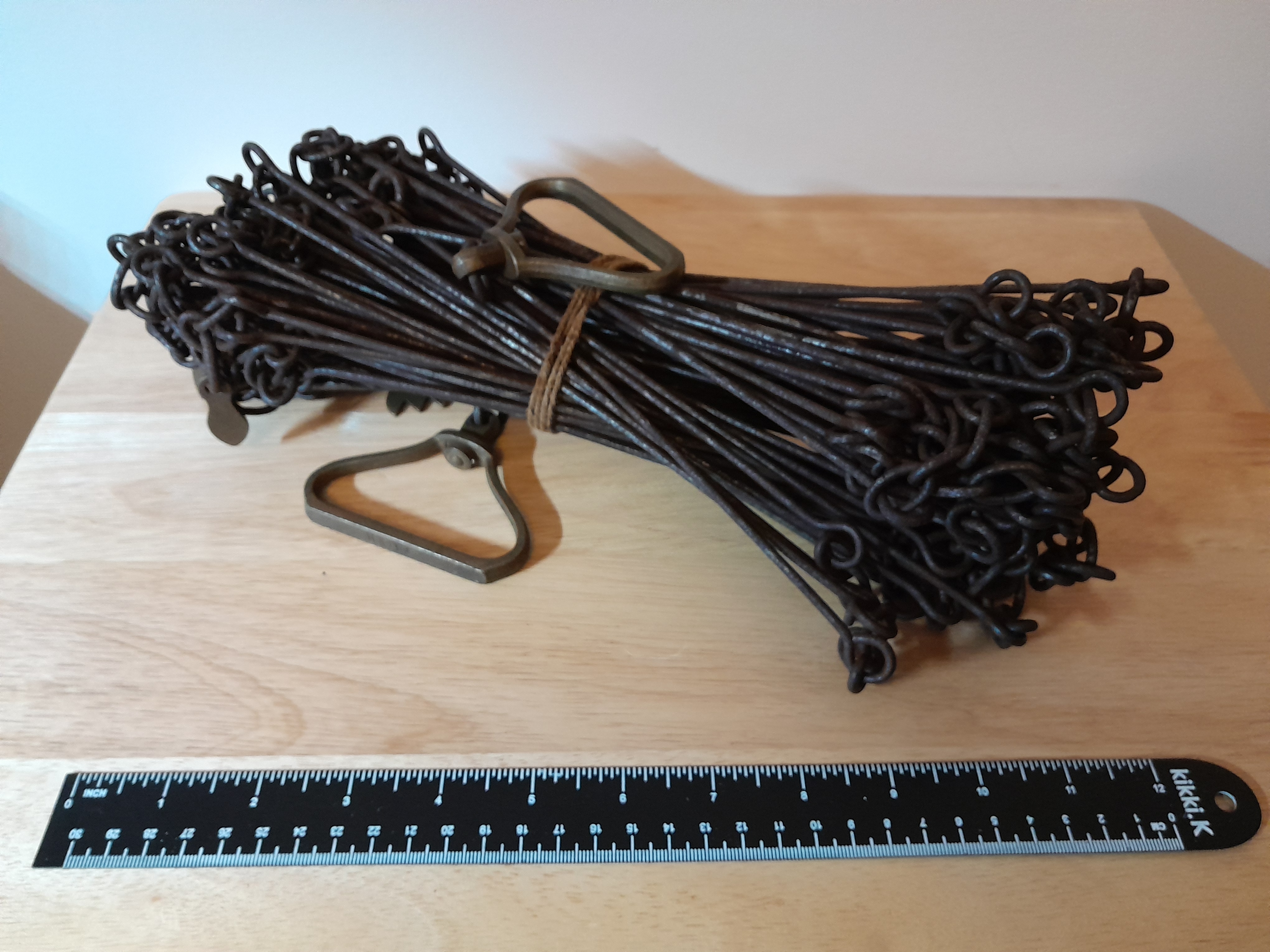
Land surveying measuring chain
100 feet chain similar to Gunter's chain but covers a longer distance. So it is Imperial measure made by Chesterman of Sheffield. Probably 1950s 0r 1960s. 10 chains = 1 furlong. 8 furlongs =1 mile. 1 chain subdivided 100 links. Each link = 7.92 ins. 1 chain = 4 rods or 4 perches each 16.5 ft.
1 cricket pitch = 1 chain. Also used still by railways.
The weights and measures act 1985 still confirms chains as a valid measurement but they are no longer used as a current measurement term
100 feet chain similar to Gunter's chain but covers a longer distance. So it is Imperial measure made by Chesterman of Sheffield. Probably 1950s 0r 1960s. 10 chains = 1 furlong. 8 furlongs =1 mile. 1 chain subdivided 100 links. Each link = 7.92 ins. 1 chain = 4 rods or 4 perches each 16.5 ft.
1 cricket pitch = 1 chain. Also used still by railways.
The weights and measures act 1985 still confirms chains as a valid measurement but they are no longer used as a current measurement term
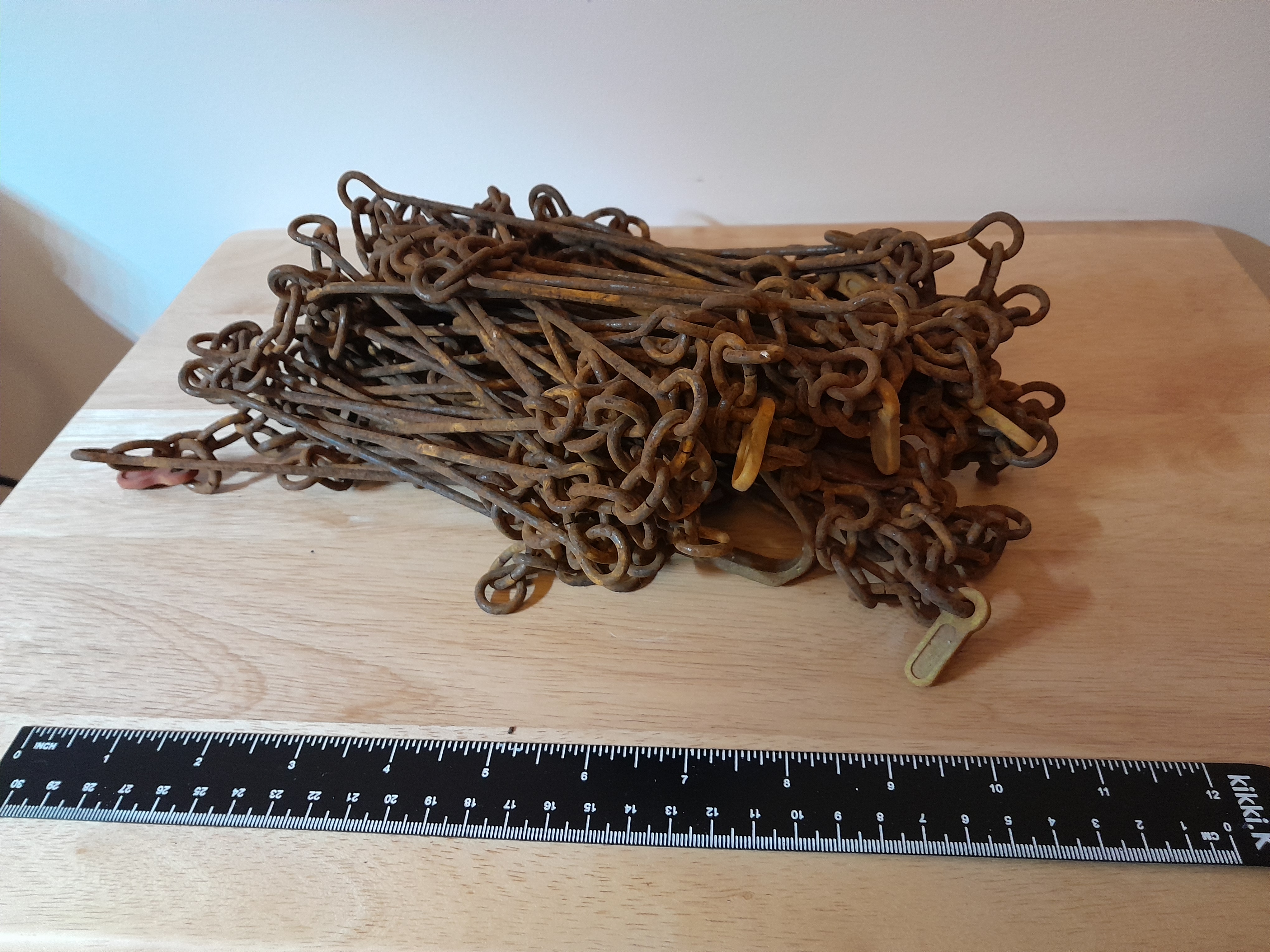
Land surveying measuring chain No. 2.
20 metres chain similar to Gunter's chain but covers a longer distance. So it is metric measure equivalent to 65 feet. Difficult to date but could be 1980s because it no longer has brass tags but plastic ones and the measurement is metric. The weights and measures act 1985 still confirms chains as a valid measurement but they are no longer used as a current measurement term.
20 metres chain similar to Gunter's chain but covers a longer distance. So it is metric measure equivalent to 65 feet. Difficult to date but could be 1980s because it no longer has brass tags but plastic ones and the measurement is metric. The weights and measures act 1985 still confirms chains as a valid measurement but they are no longer used as a current measurement term.