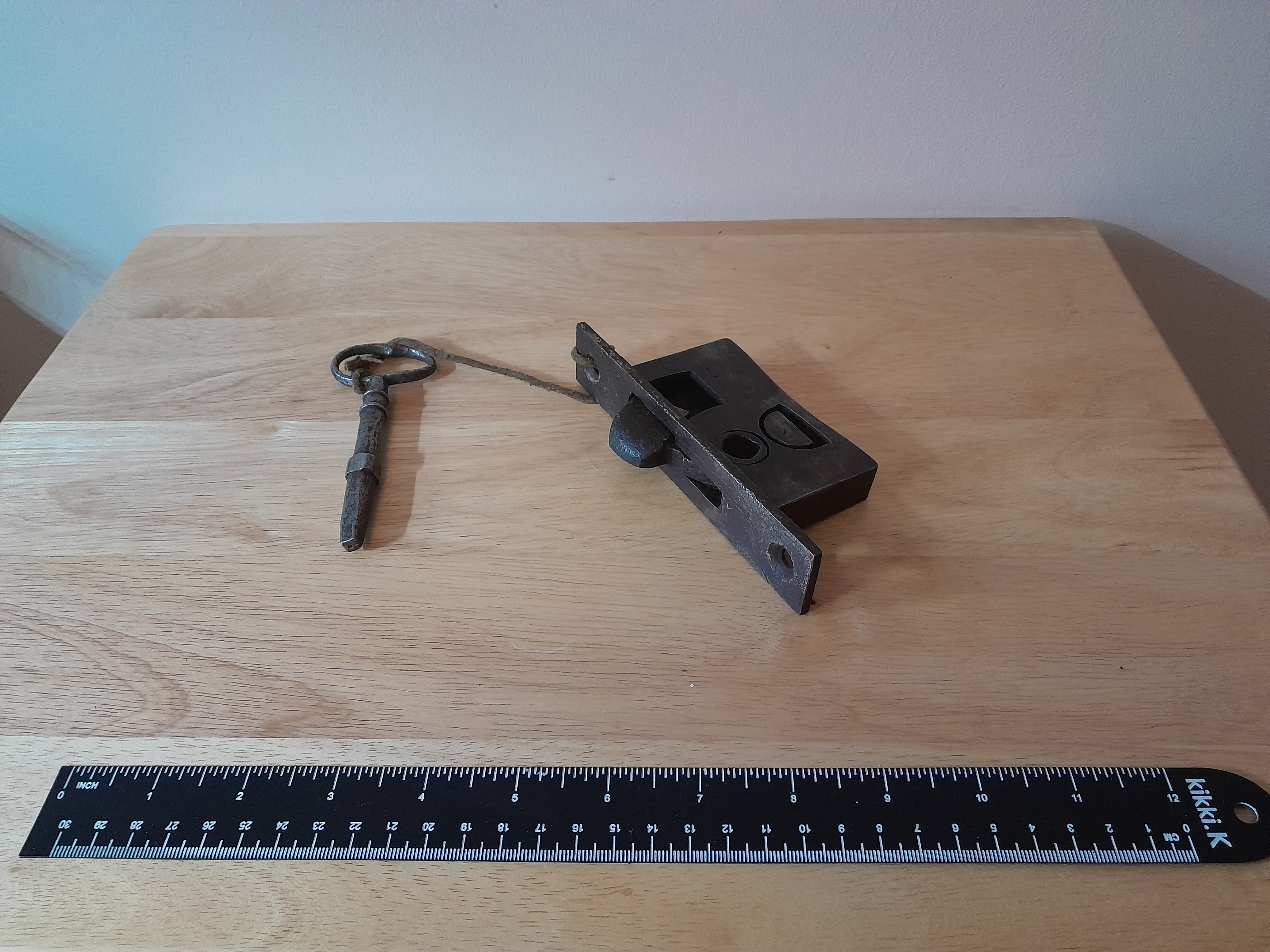
This is a very unusual lock. I am guessing by the way it looks that it is a very early slam door lock. There is no key so it cannot be locked or unlocked, but can be opened by using the removable handle provided.
It may have come off an early railway carriage, or a stage coach, or even an early Police Black Maria. Who knows? .
It may have come off an early railway carriage, or a stage coach, or even an early Police Black Maria. Who knows? .
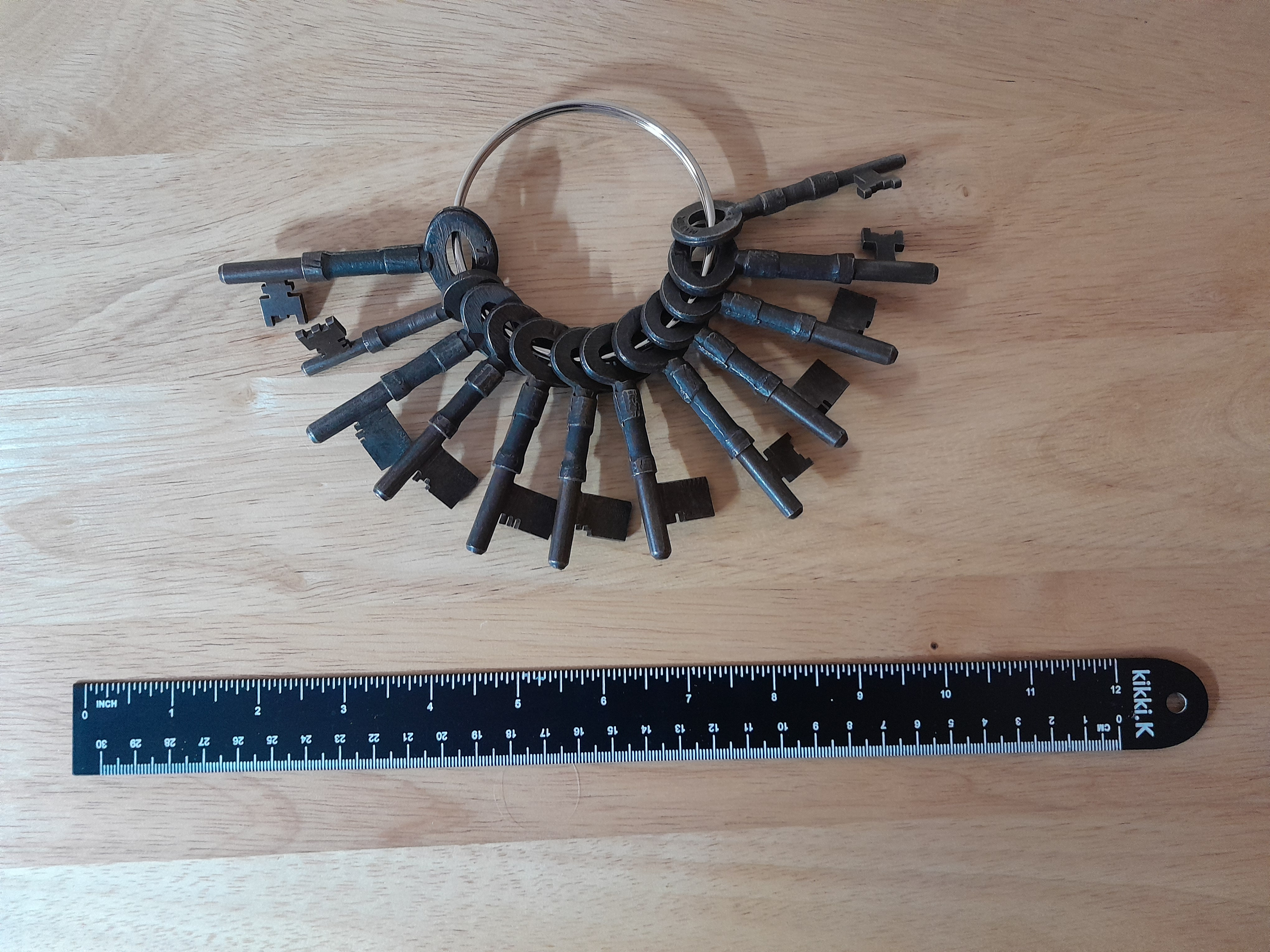
Here is a set of Gibbons keys made for either an asylum or prison which has long since been demolished. The keys on this ring are all numbered consecutively which means that they are all from the same building.
Some are similar to the key on the left which has the same pattern equalised on the shank which means you can unlock the cell door; open it and pass through it, and then lock it behind you. Some keys on the right only
have half the pattern which means that the cell door can the unlocked and locked only from the outside.
There is no provision for the cell door to be locked or unlocked from the inside.
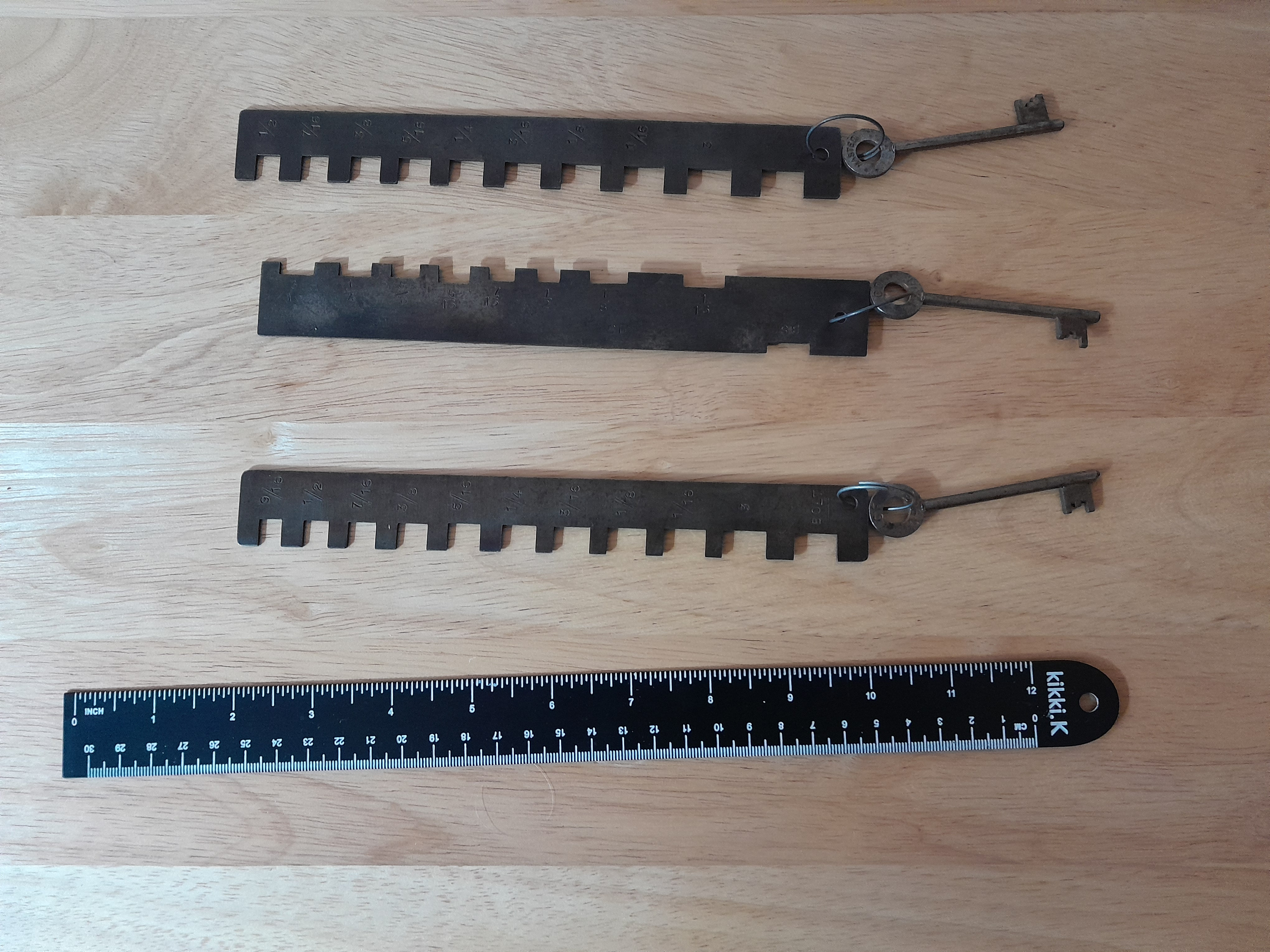
Here are three rare antique key cutting measuring guides. Attached to each is the master key produced in the James Gibbons factory using this guide. Each key is stamped 'Master' and bears the same identification mark
as the guide together with different measurement sections cut out.
Gibbons first traded in 1670 and went on to make keys for asylums and prisons in their Willenhall factory.
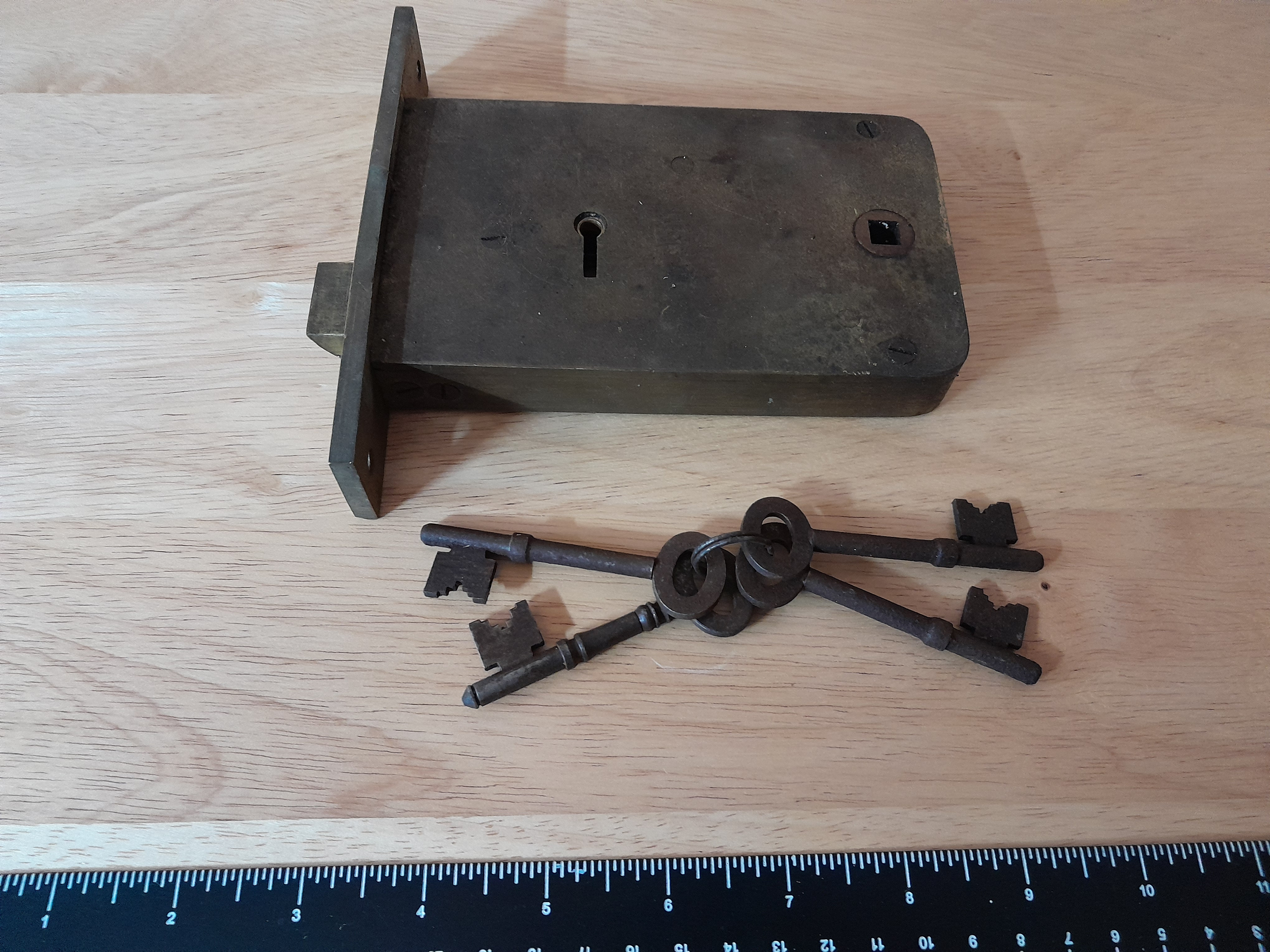
Brass Mortice Lock
This brass lock is unused and if cleaned up it would look brilliant. It was given to me some years ago. It is made by the finest lock makers, namely Chubb & Co, and has 'By Appointment to HM King' stamped on it. Chubb of London started in 1818 and first supplied locks to the General Post Office in 1823, and then His Majesty's Prison Service in 1835, both under the patronage of the King. I would guess that it is dated around 1940. The keys are not brass, hence why they are rusty.
This brass lock is unused and if cleaned up it would look brilliant. It was given to me some years ago. It is made by the finest lock makers, namely Chubb & Co, and has 'By Appointment to HM King' stamped on it. Chubb of London started in 1818 and first supplied locks to the General Post Office in 1823, and then His Majesty's Prison Service in 1835, both under the patronage of the King. I would guess that it is dated around 1940. The keys are not brass, hence why they are rusty.
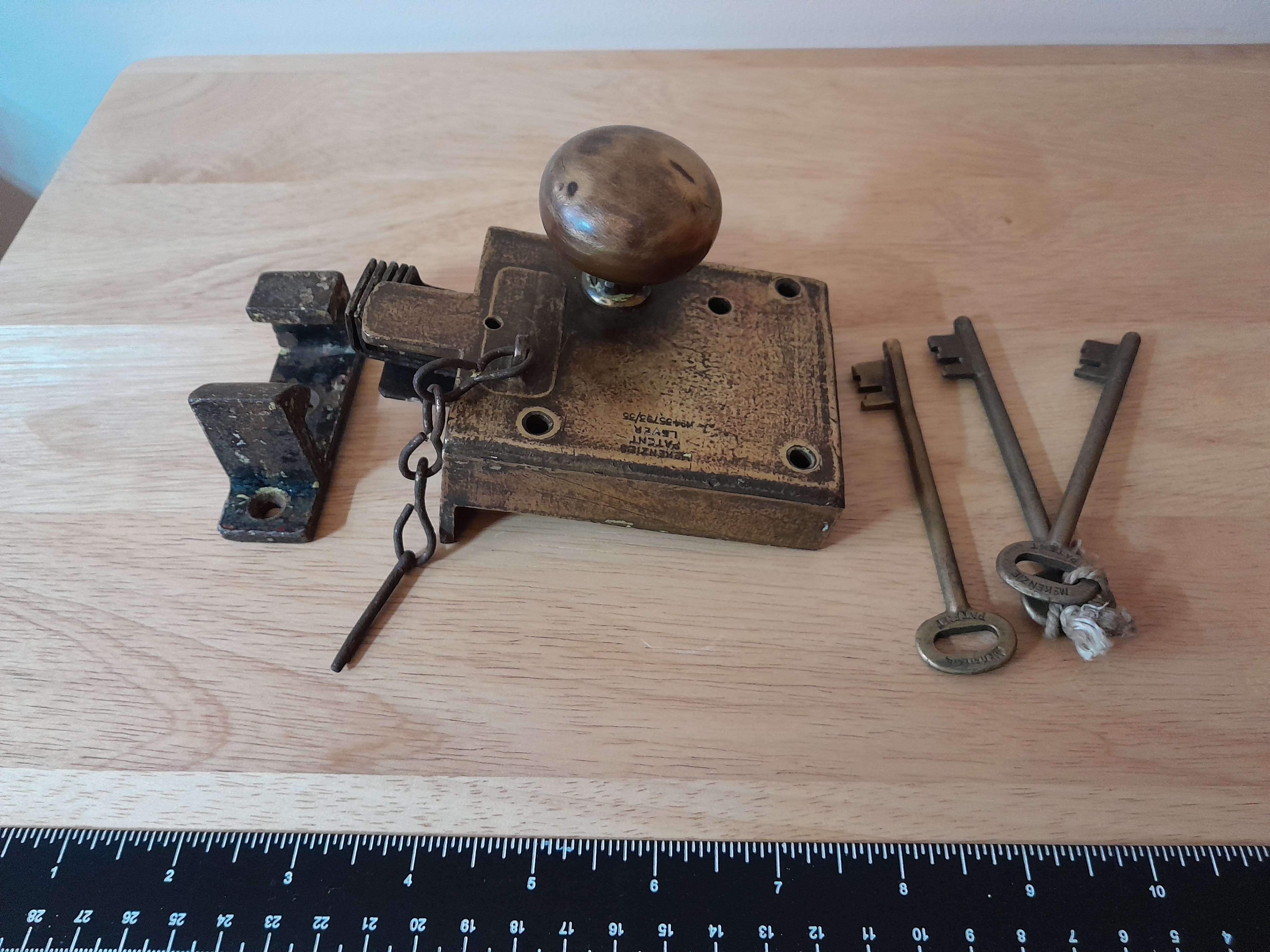
McKenzies Door Lock.
Patent lever No. 4358793/35
This is an interesting old lock that was part of an architectural salvage. The side you see has a fixed door handle and no key hole. I will leave it to you to guess which side of the door it was on. When the door was unlocked then the door handle could be turned and the five levers would move under the strike plate and then the door could be opened. The metal pin could be place in the hole in the centre of the strike plate thus ensuring the door remained unlocked. The keys are long enough to be used on the reverse side of the door where it could gain access to the keyhole in the lock. I have never seen another one, but a man who used to work in demolition remembers seeing them in the old Birmingham Stock Exchange. This building was opened in 1845 but closed in 1980 due to the 'Big Bang' when the buying of stocks and shares became digital. No doubt a lot of security locks were removed. I do not know whether or not the patent was a success but the dating to the Victorian period seems correct to me.
Patent lever No. 4358793/35
This is an interesting old lock that was part of an architectural salvage. The side you see has a fixed door handle and no key hole. I will leave it to you to guess which side of the door it was on. When the door was unlocked then the door handle could be turned and the five levers would move under the strike plate and then the door could be opened. The metal pin could be place in the hole in the centre of the strike plate thus ensuring the door remained unlocked. The keys are long enough to be used on the reverse side of the door where it could gain access to the keyhole in the lock. I have never seen another one, but a man who used to work in demolition remembers seeing them in the old Birmingham Stock Exchange. This building was opened in 1845 but closed in 1980 due to the 'Big Bang' when the buying of stocks and shares became digital. No doubt a lot of security locks were removed. I do not know whether or not the patent was a success but the dating to the Victorian period seems correct to me.
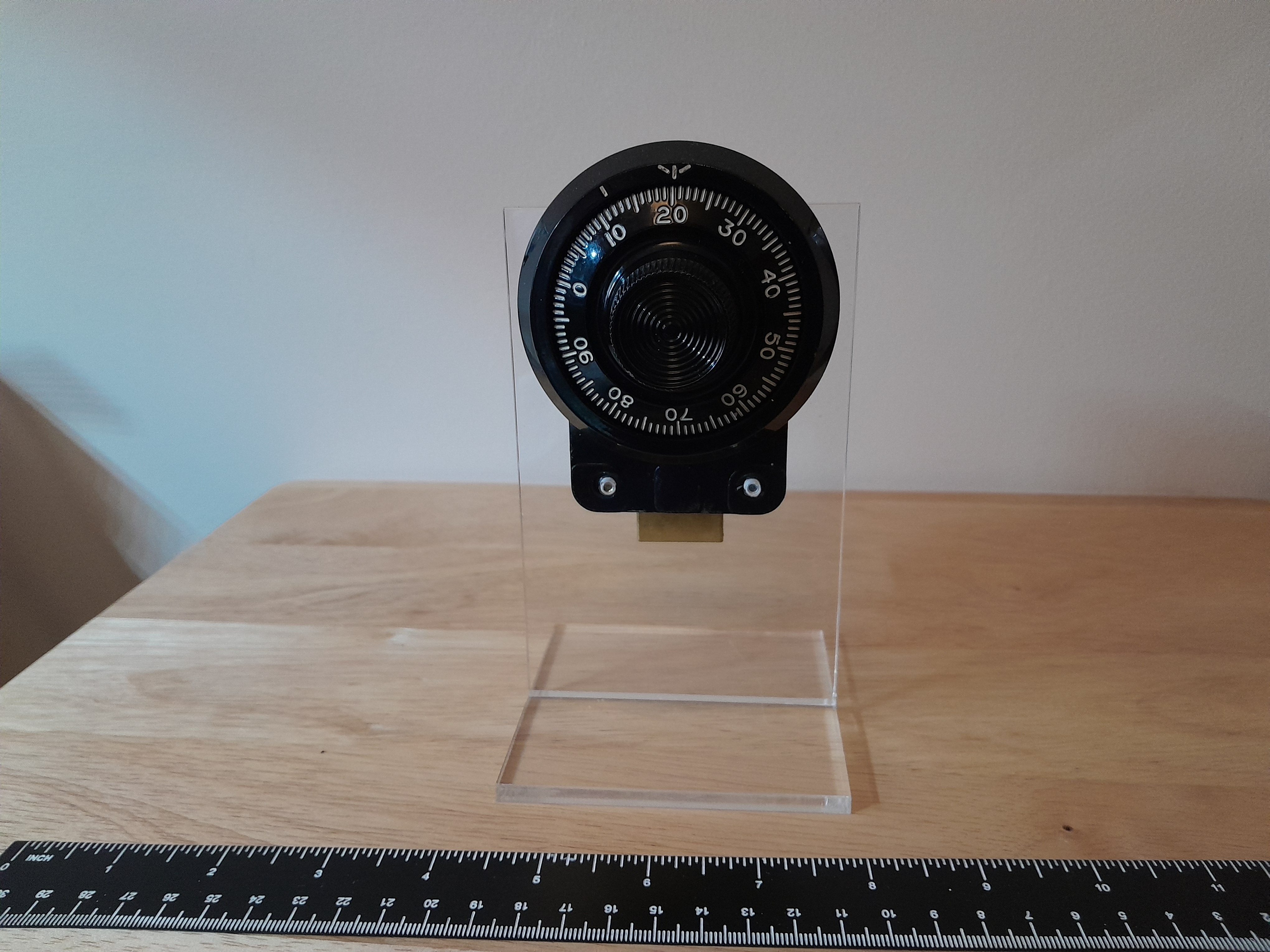
Sargent & Greenleaf Combination Lock
Model no - 6731-017 Year 01-2016 4 wheel Group 2
The James Sargent Lock Company, founded in 1857 by James Sargent, specialized in safe locks. In 1865, he partnered with Halbert Greenleaf, a former employer, to form Sargent and Greenleaf (S&G). S&G is known for introducing the first large-scale, commercially produced time lock in 1874, which marked a significant advancement in security technology. The company has since evolved into a major player in the security hardware industry, known for its high-security products and innovations.
This lock, made in 2016 is probably from salvage, and is now a demonstration model. It is a 4 wheel model and has a 8 digit combination such as 10-20-30-40. 100 million different combinations can be set.
When I worked in a bank we had similar locks on the vaults. Each vault would have two different combination locks and two staff would only know one of the combinations. Therefore two staff would each unlock their combination independently before the next stage of unlocking to key locks on the safe principle.
Model no - 6731-017 Year 01-2016 4 wheel Group 2
The James Sargent Lock Company, founded in 1857 by James Sargent, specialized in safe locks. In 1865, he partnered with Halbert Greenleaf, a former employer, to form Sargent and Greenleaf (S&G). S&G is known for introducing the first large-scale, commercially produced time lock in 1874, which marked a significant advancement in security technology. The company has since evolved into a major player in the security hardware industry, known for its high-security products and innovations.
This lock, made in 2016 is probably from salvage, and is now a demonstration model. It is a 4 wheel model and has a 8 digit combination such as 10-20-30-40. 100 million different combinations can be set.
When I worked in a bank we had similar locks on the vaults. Each vault would have two different combination locks and two staff would only know one of the combinations. Therefore two staff would each unlock their combination independently before the next stage of unlocking to key locks on the safe principle.